

WONDERCABINET : Lawrence Weschler’s Fortnightly Compendium of the Miscellaneous Diverse
WELCOME
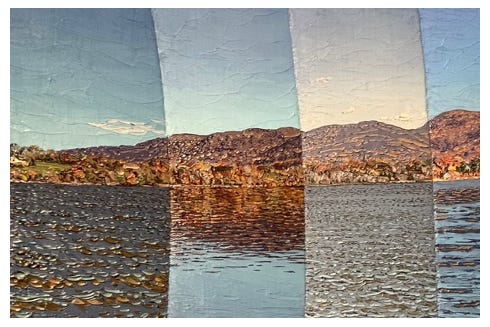
Part Two of a conversation with identical twin optical artists Trevor and Ryan Oakes, on the occasion of their current show at the Pietro Alexander Gallery in New York (thru October 29), as the boys deploy their concave-easel camera-obscura-like technique on a series of eleven-day vantages across the Hudson River, a site with a storied art history of its own.
* * *
The Main Event
Artwalk
The Oakes Twins (continued)
Readers of our last issue will already be familiar with Ryan and Trevor Oakes, identical twins who from their earliest toddlerhood, coming on forty-five years ago, were engaged in a compoundingly sophisticated conversation about the nature of binocular vision, culminating, during art school at Cooper Union, with their discovery and/or invention of a method for rendering camera-obscura-exact depictions of the world across a concave-grided canvas, deploying no other equipment than their own two eyes. Initially working by way of ink-drawing, they have in the meantime graduated to oil paint, and having thoroughly investigated the representation of space, they have recently taken to pondering ways of introducing the passage of time into their purview. The result has been a series of eleven-day concave paintings of one particular stretch of the Hudson River, a site with a storied art history of its own, work currently on display (alongside works by some of their Hudson River School predecessors) in a marvelous show now on view at the Pietro Alexander Gallery in the Soho section of New York (thru October 31)—a show for whose catalog I was asked to contribute a conversation with the artists, whose second half begins here:
REN CONVERSES WITH TREVOR AND RYAN OAKES
REGARDING THEIR THEN-UPCOMING SHOW
AT THE PIETRO ALEXANDER GALLERY
via Zoom, on August 26, 2026
PART TWO: OF TIME AND THE RIVER

Lawrence Weschler
But anyway, at a certain point, you end up on the Hudson River. Is that just a complete coincidence, or what’s happening there?
Ryan Oakes
We wound up renting a studio in an old factory building, which was on the river. And we chose that because it was just so incredibly beautiful.
Lawrence Weschler
Well, as we know, there’s a history of people, and especially artists, feeling that way.
Ryan Oakes
Yeah, the Hudson River School!
Lawrence Weschler
And where exactly are you on the river?
Trevor Oakes
We’re just south of the Beacon Bridge in Newburgh, on the west side of the river looking out towards the town of Beacon.
Lawrence Weschler
So in fact, Dia Beacon is itself just there on the other side.
Trevor Oakes
Yeah, it regularly registers as a little tiny building in the middle of our concave paintings.
Lawrence Weschler
Which is where the Light and Space master Robert Irwin built out that museum, effectively. He was playing off of vantages aiming out towards you in effect, and now you’re looking back at him, as it were. You’re also near West Point.
Ryan Oakes
Yeah, it’s on a promontory that juts out from our side into the river a bit further south.
Lawrence Weschler
So do you actually see West Point in your vantage?
Ryan Oakes
Well, you don’t see specifically the buildings. But we look right down towards the narrow channel that cuts through the Hudson Highlands mountain range. The Hudson Highlands range stretched from one side of the river across to the other. And the glacier that forged the Hudson River broke through that mountain range at that point, so you get a tighter area where the river runs deeper and faster. And, yeah we’re facing that V in the mountains. And West Point is down inside that V a little.

Trevor Oakes
So we’ve been framing the same composition for each of these paintings. And the V in the mountains is on the far-right side. As Ryan said, you can’t see any specific buildings, unless the sun is perfectly correct. But there are some days when it’s clear enough and the angle of the sun is correct and you’ll get a little tiny white dot, which is the massive complex of West Point.
Lawrence Weschler
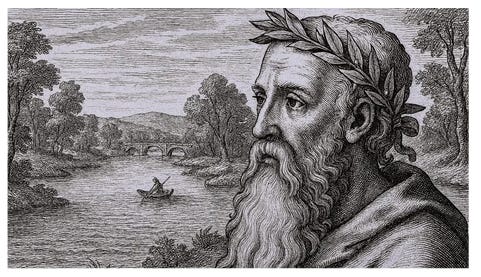
Okay. So, yes, let’s talk some more about what it is like to spend a lot of time looking at the river. One thing I would point out is that—and here we’re not just going back to Emerson, we’re going well past him, indeed all the way back to pre-Socratics, and Heraclitus in particular, who famously observed that you can’t step in the same river twice.
Trevor Oakes
Yeah, right.
Lawrence Weschler
I imagine that’s especially true of the Hudson, which is a tidal river even up that far. So that part of the time it is flowing north and part of the time is flowing south. The river itself is just completely different from moment to moment. And so for that matter are you each fresh time you step into it. Well, it is basically a metaphor for time.
Ryan Oakes
Indeed: the flow. Yes. Yes. Flow of time.
Lawrence Weschler
And that now begins to be a compelling subject for you.
Trevor Oakes
Exactly. This whole Hudson River series of ours grew out of the fact that we were going to be losing our Long Island City studio and having to find a new workspace in 2017. We wanted it to be within approximately an hour radius of New York. And Ryan spent probably six months on Google Earth, just looking at the area surrounding New York City from a really, really, really high bird’s eye view (from the moon practically), scouring the geography until…
Ryan Oakes
I zeroed in on this stretch of the river…
Trevor Oakes
…which just seemed to have the right vibe.
Lawrence Weschler
By the way, I should mention that you were effectively doing exactly what Michael Govan, the director at DIA, did in his little prop plane, prospecting, coursing up and down the River before he noticed that abandoned Nabisco Plant just south of Beacon which went on to become the new DIA site, just opposite where you settled.
Trevor Oakes
Yes: the river gets really wide there, more than a mile across, and Ryan too somehow figured out that that was going to be a good spot. We started looking on the net for commercial real estate and eventually found...
Ryan Oakes
… a factory building that was offering spaces which were unique because it was on a little spit of land that protruded beyond the freight train rails, such that the building was immediately adjacent to the river and looked out on the water directly. Whereas most of the factory buildings along the Hudson River are behind the train tracks. Both sides of the river have rails, passenger rails on one side and freight train rails on the other. We’re on the freight train side. Dia Beacon is on the passenger train side.
Lawrence Weschler
It’s interesting you mention that, by the way, because thinking about the history of the Hudson River School, in much the same way that impressionism in Paris was made possible by the commuter rail lines that began spreading out from Paris, such that artists could take day trips into the plein air (and in Paris all that train traffic even became a subliminal subject of their paintings, the smoke trails in the distance or the rail bridge near Argenteuil, as in both Monet and Caillebotte, for example,

and for that matter a generation earlier, in England, the way in which the preLuminist JWS Turner was playing off imagery of train travel as well in his great Rain, Steam and Speed painting)—so the existence of river ferries and presently rail lines made it possible for those Hudson River School guys to make their way up north and on out to those amazing vistas. Though in their case, they tended to efface evidence of the modern conveyances that eased their journeys to that supposedly untouched wilderness. Such that while the whole ideology of the imagery of the Hudson River School was “This is the American Paradise, it’s Eden. It’s completely fresh, never before seen, this gorgeous wide expanse of nature”

(much of which as we have said is coming out of Emerson and his fellow Transcendentalists of the immediately prior generation), it also has a subtext of Manifest Destiny, with so many of those Hudson River School guys first going up the Hudson and then by way of the Erie Canal, many of them continuing to head out west into all those sublime vistas that would become national parks—and in every case, it’s as if they are coming upon this paradise that’s completely unspoiled, quote unquote, notwithstanding the trains that brought them there. And of course “unspoiled” only because there are no more Indians there, they’ve all been eliminated or pushed out. The great subtext of all that painting is White Man comes upon Paradise. I mean, literally the title of the big definitive catalog from the Met’s Hudson River School show, is “American Paradise,” which completely occludes the wars of native dispossession that were taking place in that upstate area well into the 1860s.
Ryan Oakes
Yes, that’s of course all true.
Lawrence Weschler
Having said that, you were talking about a comment of Emerson’s the other day that you found particularly interesting.
Ryan Oakes
Oh, yes, in that Nature essay, the way Emerson talks about how looking out to the west, you might be aware of the cross-hatching of land ownership where this plot is So-and-so’s farm and this next plot is another person’s farm. But off in the distance, you have the horizon line, and the one who owns that beautiful, expansive view is really none other than the viewer who’s gazing upon it.
Lawrence Weschler
Which, again though, is a double-forked kind of observation. On the one hand, it’s true and it’s very beautiful and expansive, a profoundly democratic observation, the way it transcends property. But it also effaces the fact that that entire expanse did actually belong to other people before…
Ryan Oakes
And you’ve gotten rid of them.
Lawrence Weschler
So you don’t have to worry about them. And it is interesting that as of 1988, the year of that Met show, there was still hardly any mention of those sorts of issues in that catalog.
But having said that, in the case of the Hudson River School painters, they often do it by going up on a hill and looking down on some enthralling big valley expanse, as is the case with the Thomas Cole painting on the cover of the Met catalog (and for that matter you yourselves once created a somewhat more intimate concave oil painting in that style looking down on a forested expanse in North Carolina).
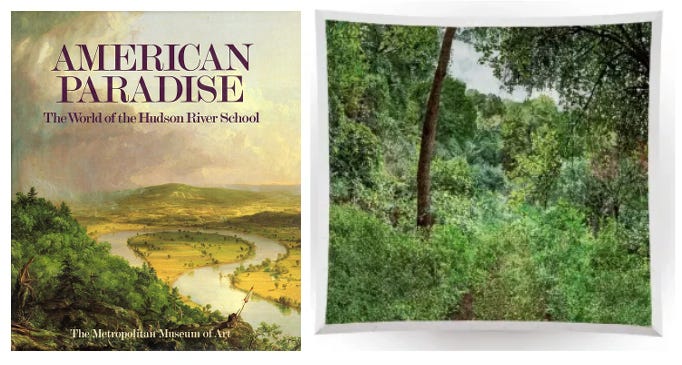
But with your own recent Hudson River series, you yourselves are down in the valley. And yet you seem to share the primordial Hudson River School concern regarding the depiction of space and light. But then you add this further element, which is a concern with registering the passage of time.
Trevor Oakes
Well, when Ryan found that location, it wasn’t at all with the intention of making paintings, but just because he felt like that would be a nice place for us to be. But upon arriving there, as we were setting up our studio, we began to notice that the weather changed significantly each day. It might be a beautiful sunny day one day and then a kind of twisted, stormy, cloudy day, the next, and a misty pastel, pale day, the one following that. You just have this incredible variation within the weather. And so little by little, the idea dawned on us that, hey, maybe we should paint that scene. I myself was of the mind that we should just pick a weatherscape that was appealing—say, some cool, cloudy pattern—pick that and start the painting on that day, mix all the colors, and then on the ensuing days, continue to mix the same color palette so that you would maintain one consistent moment within the entirety of the concave painting. Which is how all of our previous paintings had been done.
Lawrence Weschler
And parenthetically, how all the Hudson River School paintings were done. In their case, they’d literally do some sketching and then go back to their in-town studios and paint the painting as if across one single fictional day, or even moment.
Ryan Oakes
Yes, correct. The fictional sort of snapshot in time.
Trevor Oakes
But Ryan pushed in another direction. He was saying, If the weather changes, maybe we should just paint it differently ourselves with each new vertical row. And I resisted that idea pretty strongly at first.
Lawrence Weschler
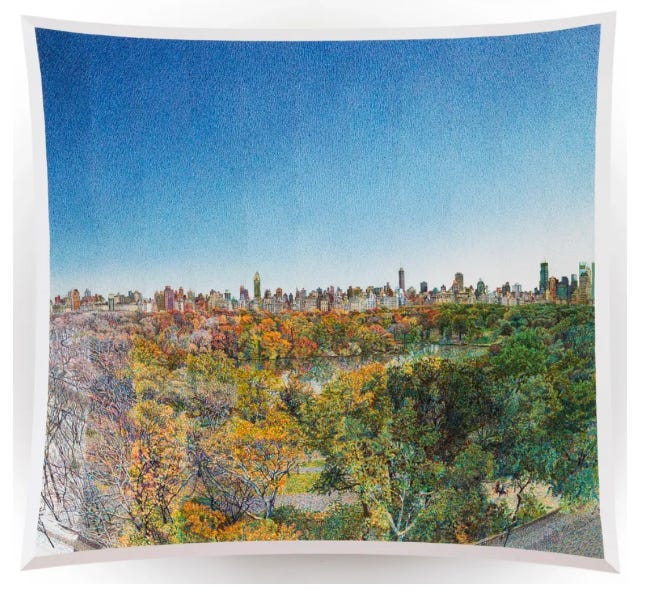
Even though you had done something like that at least once before, I’m thinking about the concave colored ink drawing you’d done of Central Park looking down from a balcony overlooking Central Park West, in which you likewise incorporated the way you did it over a series of days, albeit not one after the other but rather spread out over a whole season.
Ryan Oakes
Indeed, we started that drawing in late summer and spaced out working on it over the course of about three months, so that the finished image moved from the green lushness of summer on one side through the beginning of fall, the height of fall, the thinning of fall into the barrenness of winter. And on the final vertical row, snow was covering the ground and it was basically a white strip. So it’s basically a summer through fall into winter.
Lawrence Weschler
So you’d done that kind of thing before…
Trevor Oakes
Yes, although just to differentiate: even though that piece captured the passage of time over the course of an entire season, the weather condition as portrayed was entirely consistent—a bright, blue, sunny day throughout. So even if we were out there drawing and it was really, really cloudy and overcast, we wouldn’t change the way that the scene was drawn to respond to that light condition. We would just keep rendering the sky as bright, sunny, blue and keep the colors the same intensity throughout.
Ryan Oakes
Right. When we sort of jumped to working in the Hudson River, however, the light conditions on the water, the change of the weather, the way the light is going into the water and coming back out and how the wind speed is ruffling the surface of the water, running the gamut from extremely no-wind, making it glassy and reflective, to high wind, with little white cresting waves that are crashing all day long, and everything in between: You just had this expressiveness coming from the weather and the light that was really amplified with the liquidity of the River.
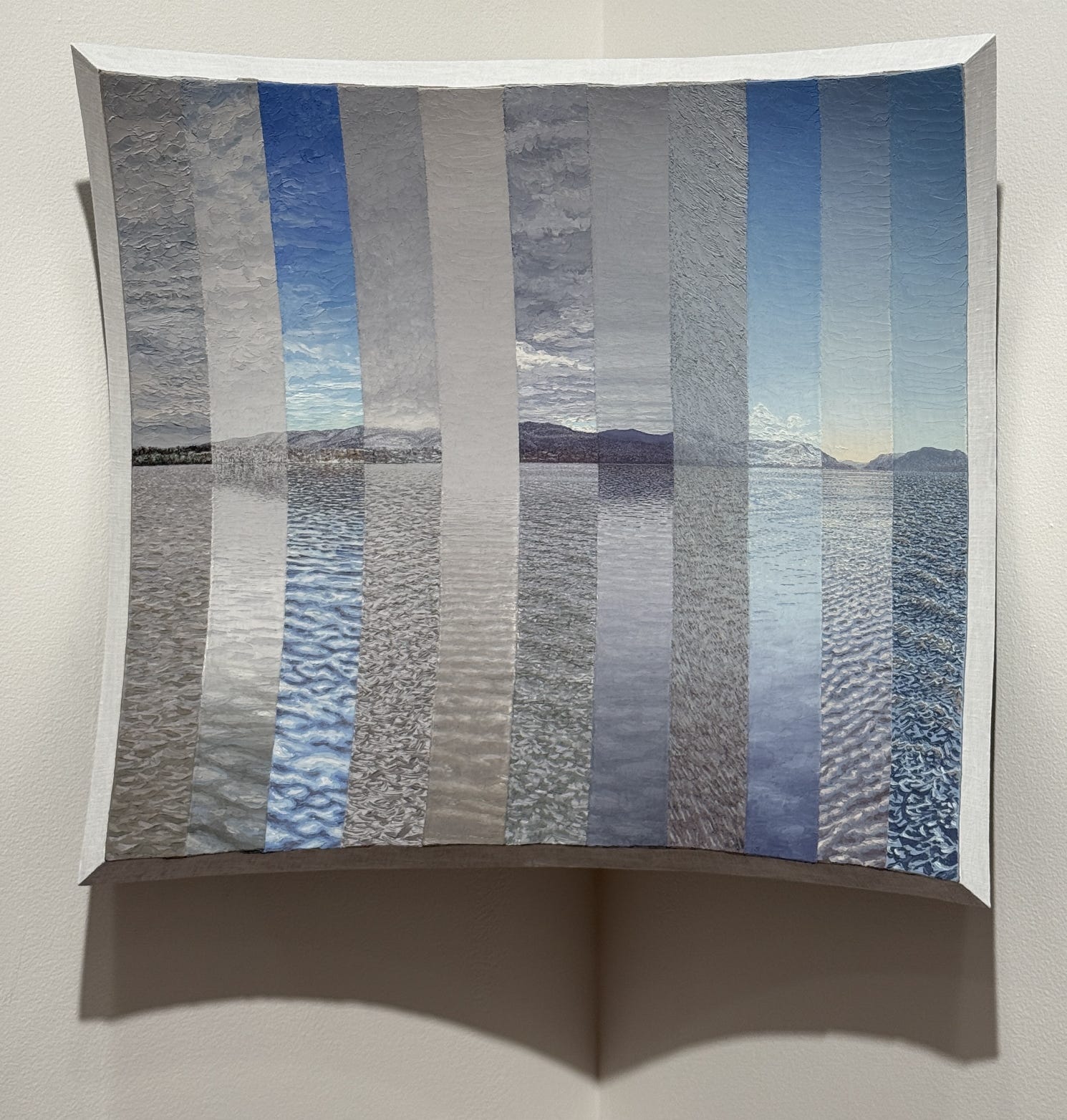
Such that the notion of starting with one weather condition, keeping that color palette and then sort of mimicking that each day, even while the weather was looking quite different— there’s such an element of guesswork that takes place there, and working from memory, that it seemed like it would be an interesting experiment and challenge to instead change with the weather and paint it how it was on each successive day. And because we were already working in these vertical strips and had those sections built into our canvas, I kind of put forth the challenge of what if we tried to complete one strip each day, reflecting whatever the weather was on that day. The weather would have changed overnight. It would be a completely different look than it was. You render that in a full day and you’d do that eleven times over across eleven days.
Trevor Oakes
The Hudson River Valley is somewhat unique in that it truly has very different weather from one day to the next. Of course, our planet is unique in that we have changing weather. There are other planets and moons where the weather is the exact same every single day for eons, including our own moon. If we did an eleven-day painting on the moon, it would look like a single moment. But Earth is special. And within the localities upon the Earth, the Hudson River is unique. I’ve heard that in, say, Afghanistan, as a woman was describing to us, it will be sunny, sunny, sunny, sunny, sunny, misty, rainy, sunny, sunny, sunny, sunny, sunny, misty, rainy. And you have this very periodic, predictable pattern to each set of seven days, roughly. The Hudson River, on the other hand, every single day is like just grabbing a card from the weather deck. So, spending time there observing that dynamic really gave birth to this idea of painting the changing weather and within three days of trying it, within three strips, it was apparent that the visual environment in the painting had become more interesting, providing your eye more to wend about within and thereby engaging your brain considerably more than would have benefited a singular moment in there.
Lawrence Weschler
What’s fascinating about light in this context is that space doesn’t change—if you’re on a hill looking down into the valley, the horizon line’s over there and it doesn’t change. But light—to the extent that you are within the tradition of people who are really drawn to the light of a region—light isn’t only a homogenous atmospheric effect, as some of the Luminists seem to focus on, it’s also extremely changeable from moment to moment. And this technique of yours taps into the glory of all that changeability.
Ryan Oakes
Yes. Yes. Yes.
Trevor Oakes
In fact light is perhaps the most changeable medium in our universe. It responds to the faintest thing, you know, a thin distribution of water vapors floating through the air as humidity is capable of changing the entire light of a scene. Whereas objects that are relatively solid, like that mountain over there, are unaffected by fluctuations in humidity. Their form still does change, but very, very, very, very slowly over seasons, years, centuries, and millennia.
Ryan Oakes
So in this instance, we thought we should try to capture some of that by painting it. And even though there’s an abrupt change from one day to the next, and the clouds for example don’t merge or blend from day to day, still, once you have that abruptness eleven times in a row, you do get a kind of balance across the overall-painting. Also, the shifts in light from one day to the next create a visual effect in the painting that reminds me of Joseph Albers’s concept of transparency, which he shows in some of his Homage to the Square compositions. The varying densities of atmosphere and changing color give the effect of different transparent veils being laid over the mountain range in the distance.
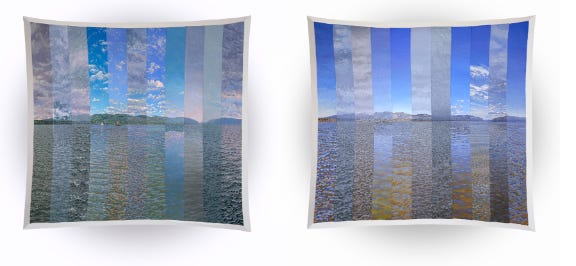
And so after having made the first piece and completing it and feeling like it felt resolved, we realized that this could become a series where we could go back to the exact same place, repeat the same idea, you know, paint eleven new days, with chance dictating an entirely different sequence of weather conditions, and we’d wind up with a completely different painting nonetheless reflecting the same idea from the same vantage point—
Trevor Oakes
—the same vantage point, the same composition, the same visual melody of mountains undulating along the horizon, but a different window of eleven days, and a different passage of time atop that same space…
Ryan Oakes
...a daily passage of time as opposed to a seasonal passage of time.
Lawrence Weschler
By the way, Trevor, you were telling me the other day about the similarities and differences between what impressionism, as it was being practiced in Paris, and this method of yours allow. And for that matter, your way’s difference with Hudson River School Luminism as well.
Trevor Oakes
So, yes, as we were dipping our toes in the water of painting the Hudson River…
Ryan Oakes
…occasionally, quite literally…
Trevor Oakes
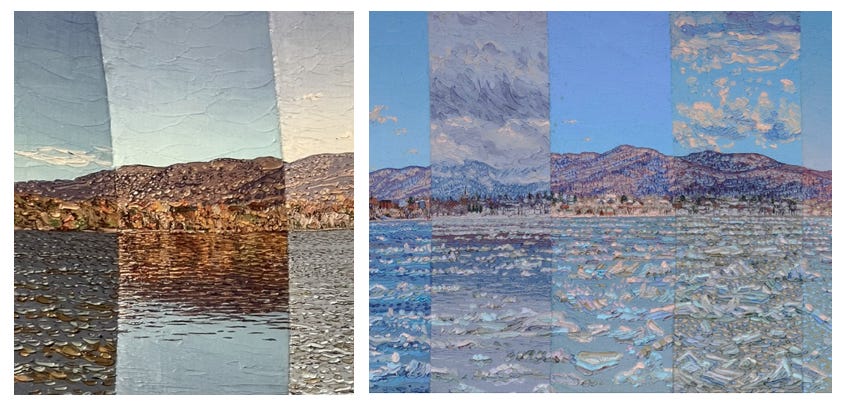
…when the tide was high. And as we began at the same time to investigate the Hudson River School to some degree, we learned that what became known as tonalism was one of the techniques that had been pioneered by the Hudson River School. Tonalism very, very roughly, was how if the day was overcast and gray, the entire painting would have a lot of gray pigment mixed into every single color, such that there was an overall gray tone to the painting as a whole. On the other hand, if, on the day you were painting, a very thin mist was hanging in the air, such that the orange-colored light of the sun was illuminating that mist and turning it orange but you could still see some of the brilliant blue sky leaking through from beyond and those two colors, orangey-red and brilliant blue, were blending to create purple, (which you have, you have these like purple days on the Hudson River where the entire atmosphere appears to be purple), then every color you mixed across the entire painting on that day would have purple in it. That was the basis of Luminist tonalism. And tonalism was happening in the Hudson River at the same time historically that impressionism was happening in France. In impressionism by contrast, quite roughly, they would be painting let’s say another gray overcast muted day.

And they noticed how you could take that gray and you could divide that color into a more brilliant teal next to a more brilliant magenta next to a more brilliant orange, each painted in small but distinct strokes. Then optically, your eye would blend those hues back together to be the smooth, original, even gray. And when you do that, when you break the gray into its constituent colors, the intensity of the orange, say, creates a tealish after-image on your retina, so when you shifted your eye a little bit and now glanced upon the neighboring teal stroke, the teal after-image in your own eye would slide atop the real teal stroke in the world, and you’d get like a double dose of teal and a sort of electrical zing from doing that. And they realized how that all’s just very delicious to look at. For my own part, I would say that in the scope of art history, impressionism really took the cake over over tonalism. Now, in our own Hudson River works, we are painting the look of the world quite faithfully to what’s actually there. So I suppose we’re working in more of a tonalist vein. If it’s a gray day, we’ll be attempting to render a smooth gray strip. So we didn’t push in an impressionist direction at all. However, after the pieces were completed, we noticed that because you had a juxtaposition of, say, eleven faithfully rendered tonal environments, one beside the next, when you were looking at all eleven of them together, if there was, say, a day which is much more orangish next to a day which is more blue, while you’re looking at the orange day, your eye would be laying in this blue after-image. Which, by the way, is how Helen Pashgian’s floating discs work as well, she shows you the after-image in such a remarkably palpable way. Indeed, viewing her work largely informed this entire theory.
Lawrence Weschler
Can you describe her work in particular for people who don’t know it. What are you looking at with her?
Trevor Oakes
So, Helen made a series of sculptures she calls lenses, which are these wide translucent circular disks cast in resin in the form of a magnifying glass lens that each balance in mid air atop a transparent pedestal. She adds pigment to their centers to create, say, a deep red hue. Then, moving outward from the center in concentric circles, that deep red hue will fade and gradate out to being the clear color of the resin at the perimeter.
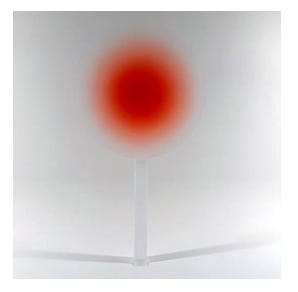
While you’re viewing the sculpture the room lights slowly fade to complete darkness and as they do a completely other color of greenish-teal, in this case, begins to appear that floats like a glowing orb in the air where the sculpture had been. It’s a very very beautiful light that seems to be out there in the real room but in fact its being produced by your own brain. Helen managed to implant that orb of light inside your own brain. And she created an environment where you can sit there and readily observe this brain light. {The effect even works with photos of the lenses to some degree. Stare at the center of the orb in the photo above for twenty or thirty seconds and watch what begins to happen.}
This glowing effect within the brain is called the after-image and is what the impressionists were also tapping into. However, with the impressionists, it would be very difficult to figure out the after-image in play. The same thing in the real world. We’re looking at our computer screens right now. Each of us is having the negative image of the computer screen burned into our eyes as an after-image. But if your brain notices it you would likely just blink it away to get back to viewing the real world. Helen, however, presents the afterimage to the viewer in a way where you can really look at it and really think about it and really come to understand how it’s behaving.
Ryan Oakes
...so you can you can be moved by it.
Lawrence Weschler
And how does that work with your pictures?
Trevor Oakes
Yeah, so bringing this back, what it made us realize is that when you are painting, you’re painting with the external palette that you’re mixing colors on—on the physical palette you’re holding in your hand you’re blending the bright red, yellow, green, blue into the tones that you want to use in the painting. But you are also painting with a second palette that’s in your brain—the palette of the after-image. So you’re really painting with two palettes, an external one and an internal one. And it took a long time, studying hundreds of varying light condition on the Hudson, and seeing Helen’s work, to understand that that is in play.
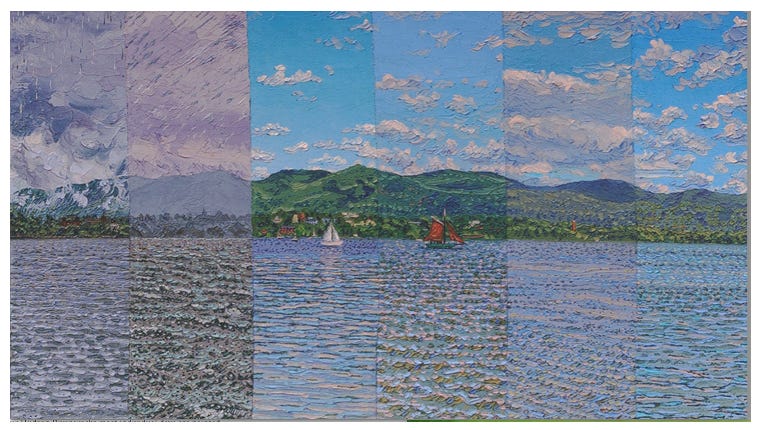
Okay, so getting back to the beginning, after painting eleven days quite faithfully to what each day looked like, we noticed that because the days themselves are of such radically different tonal environments that when you look at the painting after the fact, you get some degree of this impressionist doublejuicing, this amplification by way of which the orange day makes the blue day look more blue and the blue day makes the orange day look more orange and the purplish day makes the yellowish day glow more…
Lawrence Weschler
There’s a kind of smear of the impressionist sensibility though spread across time, over the entire composition.
Ryan Oakes
Yes, yes, exactly.
Trevor Oakes
That effect was coming up because of the close juxtaposition of different days as opposed to the impressionist subdividing of a given color into its constituent parts.
Lawrence Weschler
While I can see how in your Hudson River works most individual days are painted more tonalistically, have there been any instances when you and Ryan have wanted to lean towards a more impressionist approach?
Trevor Oakes
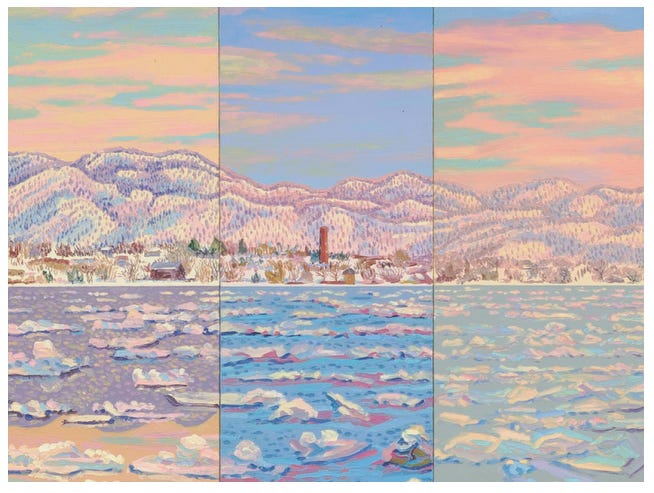
Very recently, sort of. Trying to get better at painting bright sunny days initiated a slight shift towards Impressionism.
In the real world, there is so much electrical stimulation in your eye when the light is as bright as it is on sunny days. All that light widens the color gamut outdoors tremendously. And while we could light our paintings with bulbs as bright as the sun, to recreate this wide color gamut and this high degree of electrical stimulation in a viewer’s retina, it’s unlikely that we will. The gallery would simply be too bright—like enough so that people would put on sunglasses indoors.
However, another way to infuse the viewer’s eye with that level of juicy glow is to employ impressionistic color separation and draw up the activity of the after-image within the eye. So, to get our paintings of sunny days to glow more like real sunshine, we have begun to lightly explore impressionistic color separation techniques, as well as simply ramping up the yellow and red content in the white paint on sunny days to communicate the rosy-peach hue of bright sunlight.
Lawrence Weschler
Alright then, though, beginning to wrap all of this up as it pertains to the coming show: you have decided to take one particular piece that you did out there on the Hudson en plein air, and now, bringing it into that studio of yours there in North Carolina, you are endeavoring to blow it up into a big, eight-foot-square version of its prior self…
Ryan Oakes
Yup.
Lawrence Weschler
…which in a way is more like what the Hudson River School people were doing all along. They’d do their research, as it were, sketching away out there in the field and then come back to their in-town studios to actually perpetrate their large paintings.
Trevor Oakes
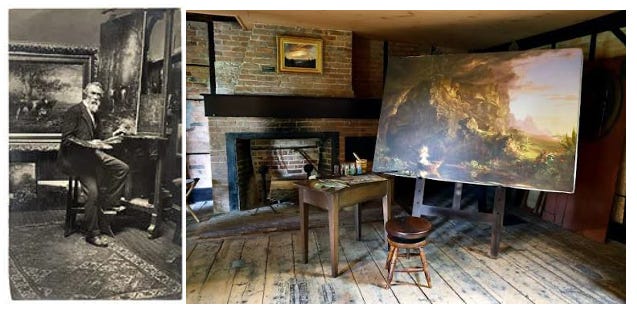
Thomas Cole said he brought his field sketches into the studio, let them sit a while, then made big paintings from them including only the visual elements that held strong and still spoke to him after sitting. Painting our big paintings feels a bit similar.
Lawrence Weschler
So what’s that been like?
Ryan Oakes
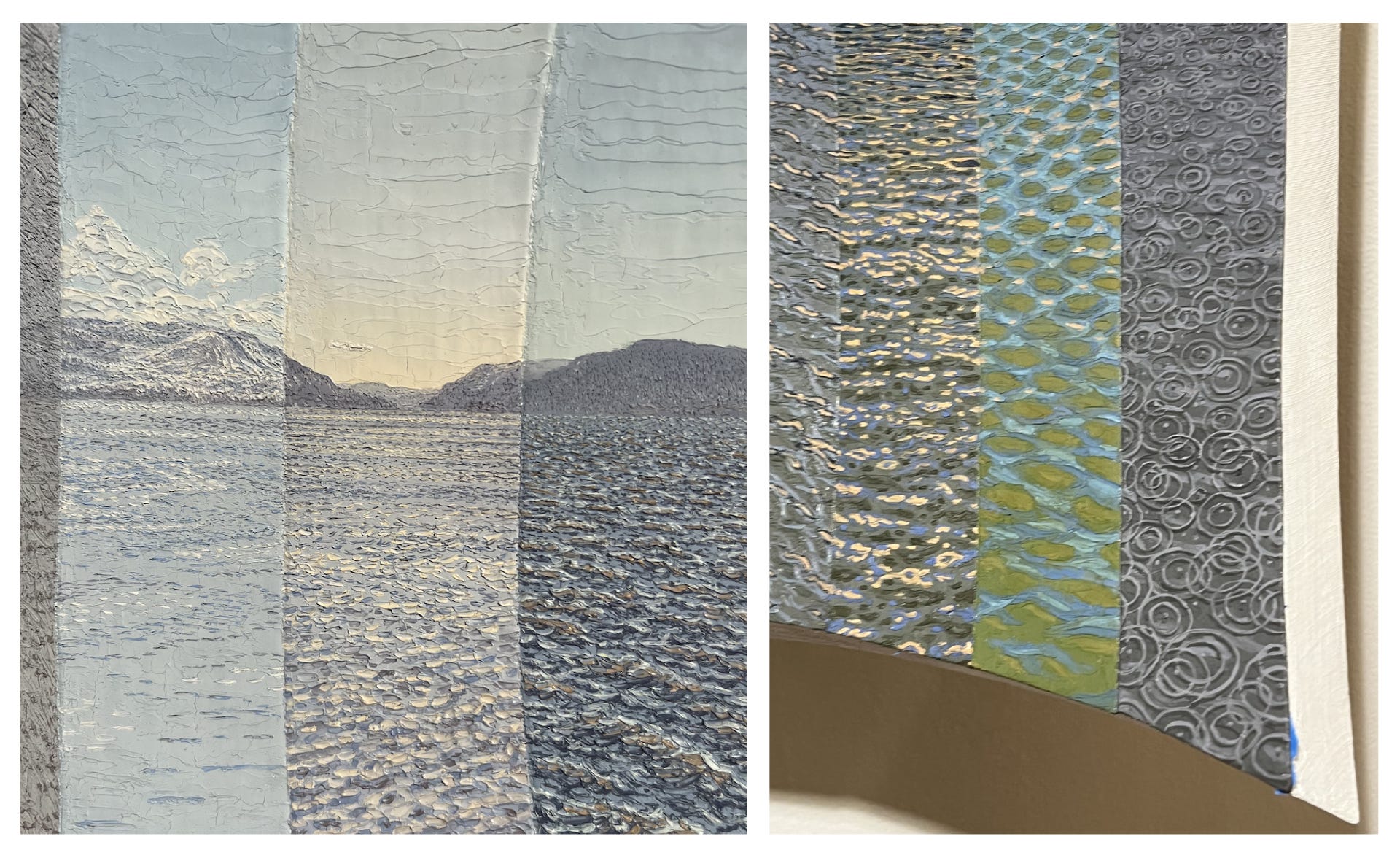
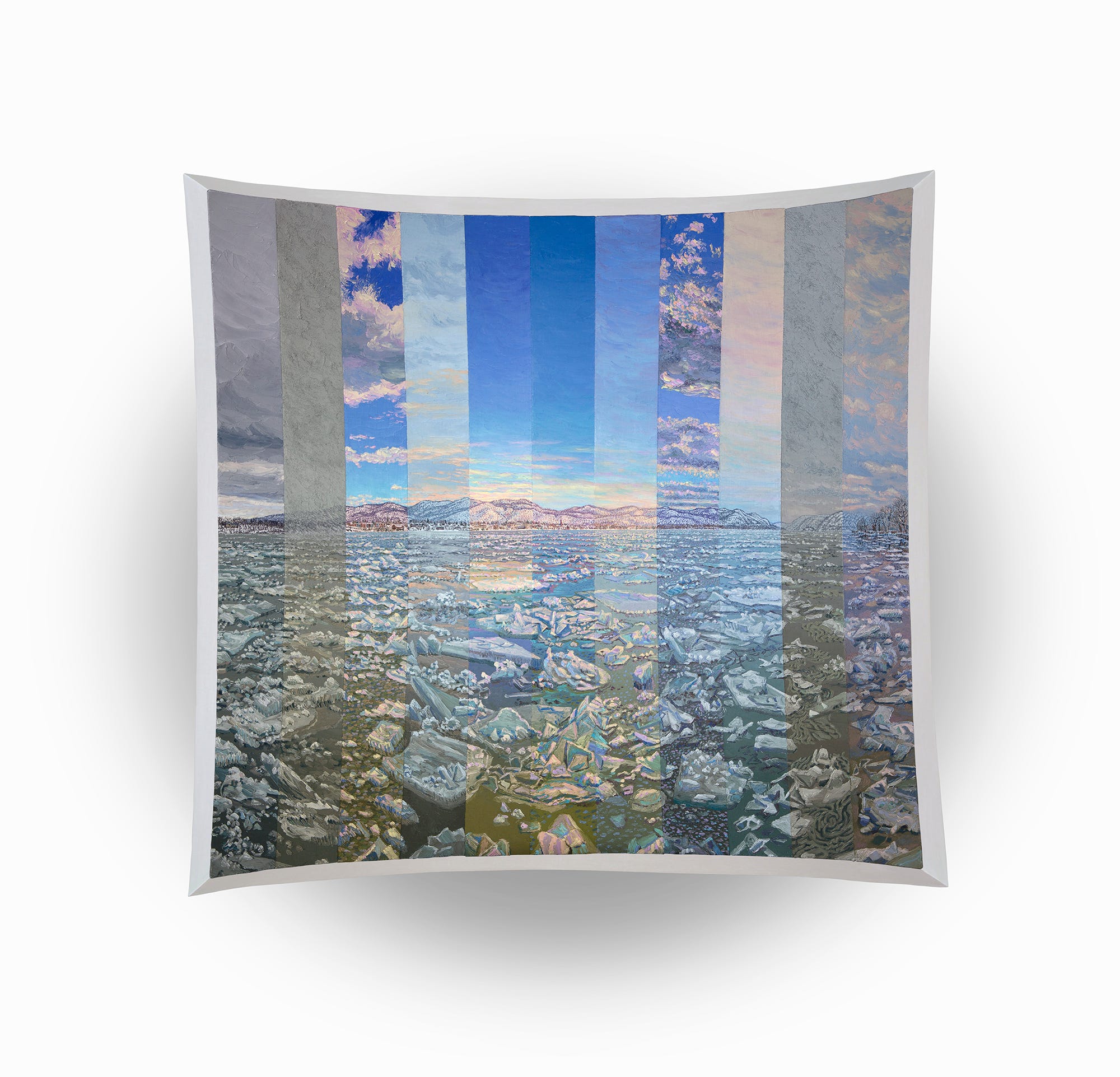
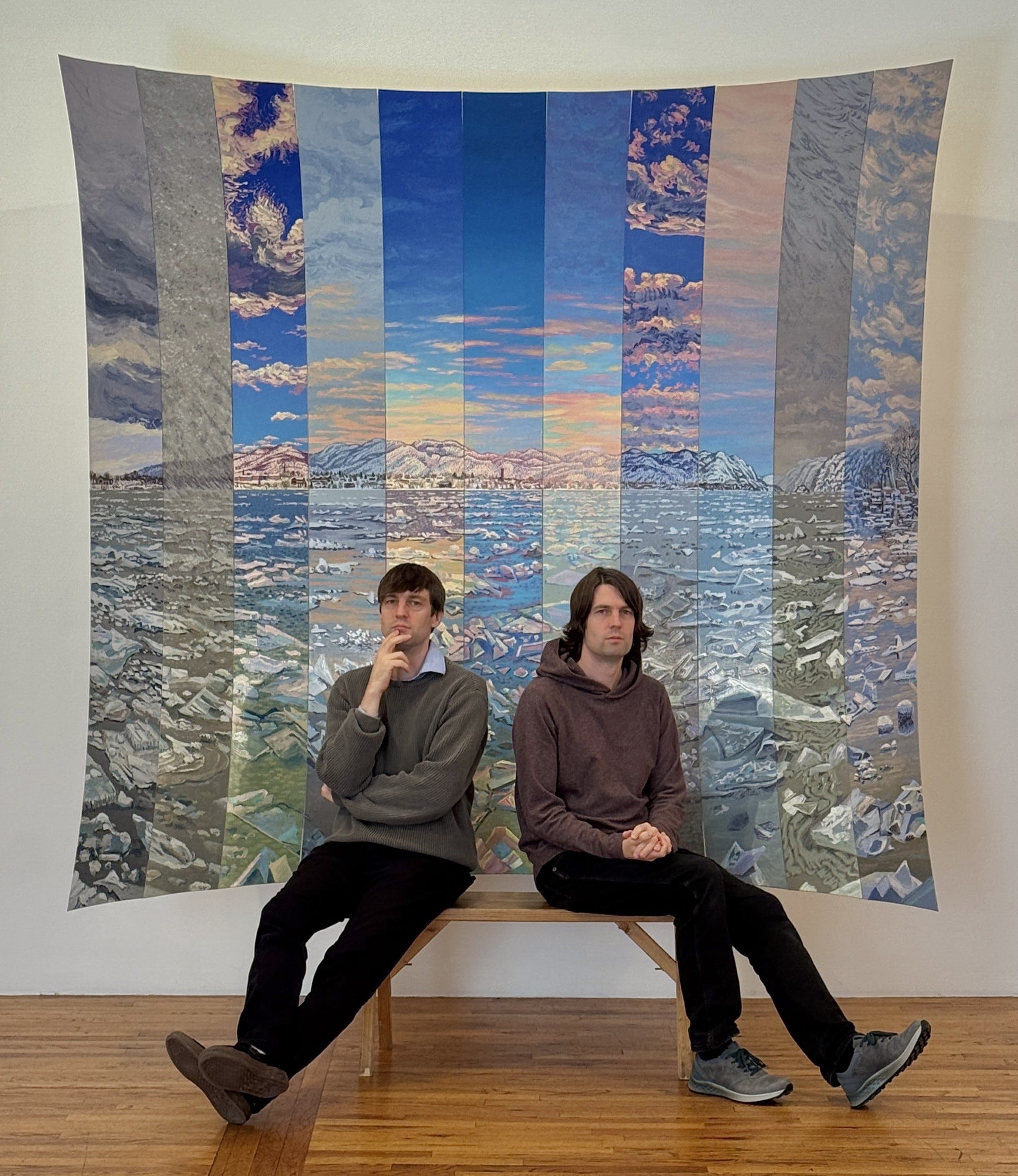
Well, it’s been going quite well. This is the first piece that we’ve attempted at that eight-foot scale. We elected to use one of the initial capture paintings that was made on the banks of the Hudson River. We are treating the original, which like all of them is about 21 inches wide and 20 inches tall, as a kind of maquette, you could say. So we sorted through the different images and chose one that we felt was strong, the one from late winter when the ice floes were beginning to break up and course down the river toward the sea. And we’re then repainting it strip by strip at a four and a half times the size.
Trevor Oakes
It’s four and a half times the edge length and 19 times the surface area.
Ryan Oakes
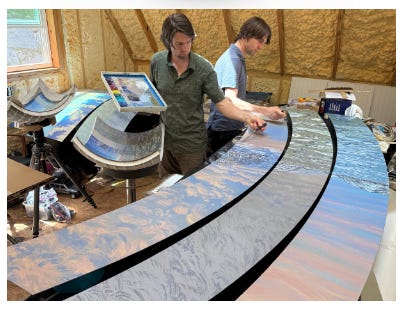
Yes, exactly. And the translation thus far is going fine. In honor of our original practice, and also owing to the obvious time pressure of the upcoming show, we’re trying to do one strip per day, and it’s working very well since we’re working wet-into-wet oil paint.
Trevor Oakes
David Hockney used to say, all you have to do with your strokes is get the mind going. His ability to paint big with a simplicity of strokes has definitely influenced the strokes on our first eight foot painting. As opposed to the Hudson River School works which were four-by-eight feet and highly intricate.
Lawrence Weschler
I imagine for one thing, in terms of contrast, that you must be painting from your shoulder rather than from your wrist.
Trevor Oakes
Yes, it’s a very different kind of stroke. Though as with the originals, it is still being done with a palette knife, and the reason’s the same: It’s really fast to change colors with a palette knife. You just have a paper towel next to it and with two quick swipes, you can completely clean it and then pick up a new color. You also mix the colors on your palette with that same knife and then paint from there. With the original piece, when it was winter-time and I was wearing a glove, I didn’t have to set a brush down to pick up another brush: a palette knife is just the best tool.
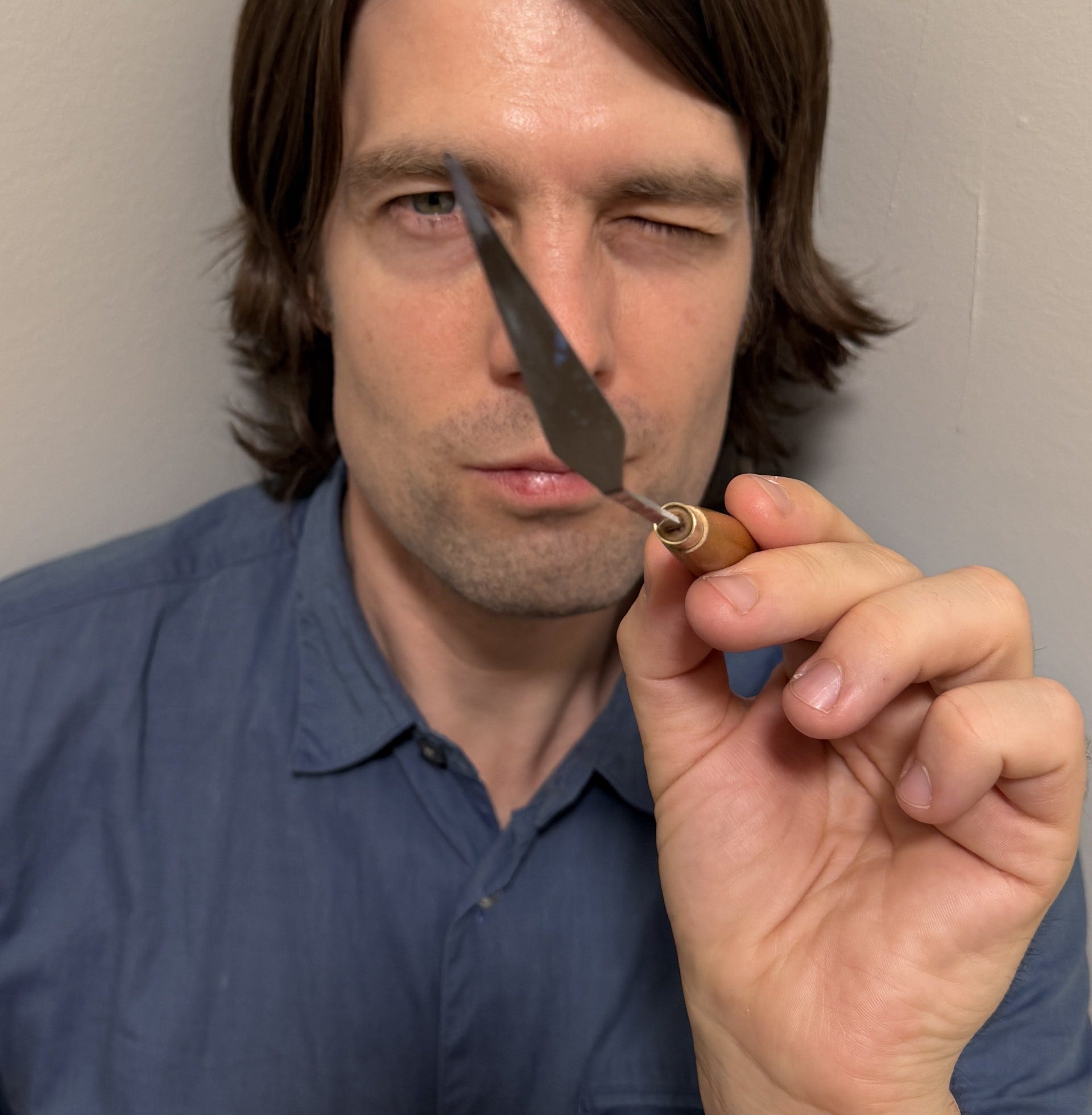
With the large piece, we’re also using palette knives and it’s a slightly different stroke, but we’ve been able to scale the palette knives up to be about four and a half times as big as the one the original paintings were made with, so we can get similar scale strokes.
The other big difference between the original scale initial capture paintings and the eight-footer is that our easel is designed for one person to be standing at the easel, so typically one or the other of us will start a piece and then complete it. And I myself have ended up painting many more of the pieces because I’ve gotten more practice at the eye-splitting technique. But at this large scale, it’s possible for both of us to be applying paint to the canvas. We both have a large scale knife and it’s easier to have a dialogue as we look back and forth at the maquette.
Ryan Oakes
With, say, one of us laying in the gray across the sky while the other is mixing the colors for the upcoming passage of the land, working in tandem in layers.
Lawrence Weschler
So you’re back to the kind of dialogue that took place when you were 10 and 11 years old.
Ryan Oakes
Yes, it’s a real throwback to that period of our lives in terms of this collaboration.
Lawrence Weschler
Another interesting difference between the maquette and this new version is that with the former, the original, there was an ideal place from which to see them, which is basically where your skullcap had been, whereas with the new version, obviously, one is going to be able to look at it from further away, indeed it will kind of demand that of you. And it’ll be a different experience.
Ryan Oakes
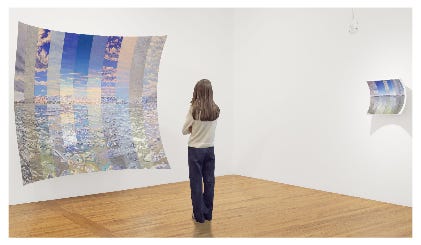
Yeah, with the original pieces, ideally you would need to lean forward and be about 13 inches from the surface of the painting. Some people would indeed lean in that far, but a lot of people would stand two and a half, three feet back. That’s just kind of a natural viewing distance when looking at any painting. We think that with the much larger painting, the sweet spot now will be like four and a half feet.
Trevor Oakes
It’ll be almost five feet.
Ryan Oakes
Let’s think 13 times 4.5…
Trevor Oakes
It’s probably about a six foot radius.
Ryan Oakes
Maybe five feet-ish. It’s about five. And so now the sweet spot is standing five feet from the surface of the painting. That will be a more natural place where viewers will find themselves winding up, without really needing to lean in.
Lawrence Weschler
They’ll end up there because it just feels right.
Ryan Oakes
Yeah.
Trevor Oakes
It will also be the case now that to look at the sky, you’ll have to turn your head up. And to look at the foreground water, you’ll have to tilt your head to look down.
Ryan Oakes
Which again are movements of the body more in keeping with what it would be like in real life if you were standing there looking at the actual scene.
Lawrence Weschler
That being a point that David Hockney made too with his big Grand Canyon vista paintings. Which brings us back to a final point that I’d like to suggest. It seems to me that with the original Hudson River School, as was made even more evident in the characterization of its final phase, Luminism, the character of light was one of the main subjects of the painting: the atmosphere between you and the thing you’re looking at, the moisture of the atmosphere, say, was of as much importance as portraying the thing beyond it. And that becomes a whole theme going forward, you’d find it in Rothko and Helen Frankenthaler and so forth. But by the time one gets to Irwin and Turrell, the theme is no longer so much light atmosphere (even though the movement gets called Light and Space), as perceiving yourself perceiving, as Irwin would say. So the light of the gaze, its character, becomes the principal subject of inquiry. What exactly is it like to perceive things? Which brings us back to the conversation you two have been having since you were toddlers, it seems to me.
Trevor Oakes
Yes, the act of looking and observing the act of looking, as you were noting at the beginning, was always the motivating force…
Ryan Oakes
…which got this whole trajectory started for the two of us.
Trevor Oakes
That started the conversation and then ultimately led to making works of art in response to that conversation. This Hudson River body of work adds to that this element of time as depicted through changes in light. Because the atmosphere is changing, the clouds are changing, but really it’s the color…
Ryan Oakes
…of the light that is what’s manifesting that difference…
Trevor Oakes
…from one day to the next. And so yes, it’s perception expanded over the window of eleven days.
Lawrence Weschler
Which you are inviting us as well to wake up to.
Trevor Oakes
As I was saying to a friend of ours quite early on: these differences from one day to the next that sometimes you wouldn’t even notice—us included, that we hadn’t even noticed—become apparent when you juxtapose them that closely. You walk out in the morning, you look at the color of the light, you start mixing it on the palette, you lay the strokes down, compare them, see if they’re correct, adjust them if need be.
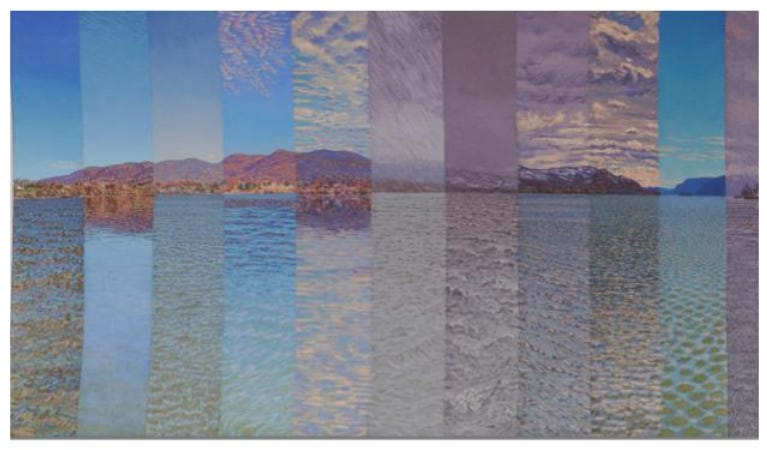
And a slight increase in humidity, let’s say, from one day to the next will cause the entire palette to turn more pastel. But you might not have noticed it if you didn’t have a record in pigment of what the previous day had been. So even for us, it opened an ability to observe light with a level of nuance that was not there…
Ryan Oakes
…before it was recorded in paint. Yeah.
Lawrence Weschler
Let there be light and let it be noticed.
Ryan Oakes
Yes, yes.
Trevor Oakes
Exactly.
* * *
ANIMAL MITCHELL
Cartoons by David Stanford, from the Animal Mitchell Publications archive.
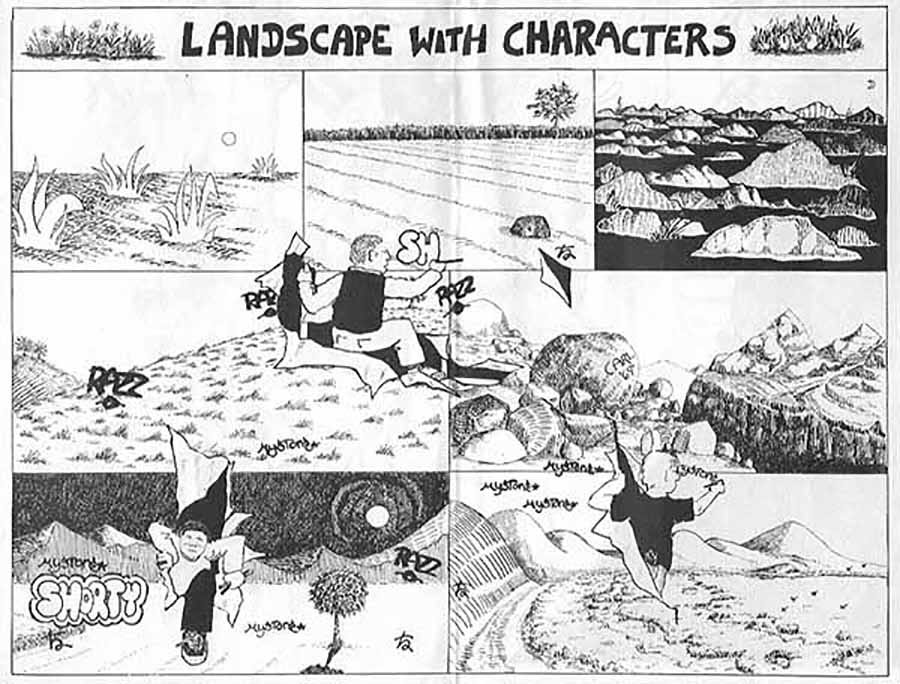

Please check out Weekly Strip. And you can order a four-booklet Animal Mitchell starter kit here.
* * *
NOTE: For those of you who can’t afford a paid subscription right now, you can still access a free option by clicking HERE and selecting the option on the far right.
Thank you for giving Wondercabinet some of your reading time! We welcome not only your public comments (button above), but also any feedback you may care to send us directly: weschlerswondercabinet@gmail.com.
Here’s a shortcut to the COMPLETE WONDERCABINET ARCHIVE.