


WELCOME
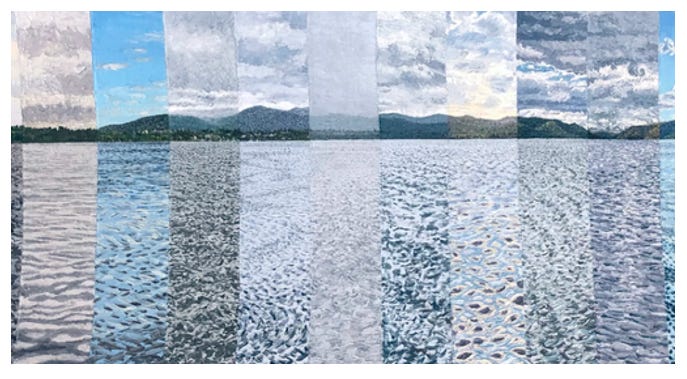
On a terrific show, currently up in New York, of fresh work by identical twin artists Trevor and Ryan Oakes, in which they broaden their revolutionary technique for depicting space by introducing the passage of time itself, by way of a series of eleven-day vantages across an upstate swath of the Hudson River, a landscape with its own deep painterly history.
The Main Event
Artwalk
The Oakes Twins: Of Time and the River
I have been following the dazzling perceptual investigations of identical twin artists Trevor and Ryan Oakes for almost twenty years now, ever since they began pioneering a novel method for depicting the world by way of a camera-obscuralike technique deploying no further equipment than their own two eyes. Back in 2014, when I curated a show of their perspectival and perceptual breakthroughs at the National Museum of Mathematics, they were primarily drawing across concave panels using fine black ink (and occasionally colored) pens. But in the years since they have been turning to the expressive possibilities of oil paint, as in a recent series of exquisite vistas prized across the Hudson River from the far side opposite Beacon, each one capturing a fresh sequence of eleven consecutive days (with their continually shifting and distinctive atmospheric conditions). Speaking of the passage of time, some of the results are now on view at the Pietro Alexander Gallery (through October 29th) in the Soho section of New York, displayed alongside the vantages of some of the Twins’s historical predecessors, artists from the Hudson River School who trained their own eyes on the same sorts of light and landscape back in the nineteenth century—a show for whose catalog I was invited to contribute a zoom conversation with the Twins by way of introduction. Which herein follows:
REN CONVERSES WITH TREVOR AND RYAN OAKES
REGARDING THEIR THEN-UPCOMING SHOW
AT THE PIETRO ALEXANDER GALLERY
via Zoom, on August 26, 2026
PART ONE: INSIGHT & METHOD

Lawrence Weschler
One, Two, Three, Four: Action!
Hi, guys, this is Ren Weschler from here in my home office in New York, and today I find you two in North Carolina, right?
Ryan Oakes
Yes, yes.
Lawrence Weschler
Which is where you have another studio besides the one you have on the Hudson River, and where you’re currently painting the big eight-foot version of one of those concave Hudson River pieces at this very moment.
Ryan Oakes
Yes, all of the production is happening here. That large eight-foot painting, as well as the final backings on the seven or so original-scale paintings that will also be in the show.
Lawrence Weschler
Since we’re going to be talking about your work on the Hudson River in the context of the Hudson River School and Luminism and so forth, I thought we might start with the patron saint in many ways on the literary side of what would become the Hudson River School, which is to say the great transcendentalist from the immediately prior generation, Ralph Waldo Emerson.
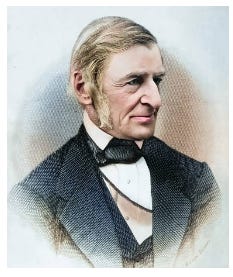
We were all looking at his little short essay “Nature,” and there was a particular passage there that I found quite pertinent, the one where he writes, “The lover of nature is he whose inward and outward senses are truly adjusted to each other and who has retained the spirit of infancy, even into the era of manhood.” We will indeed presently be talking about inward and outward, but maybe we could start here by talking about one of the things that I found fascinating about the two of you when we first started talking almost twenty years ago, in 2007…. You were both 25 at the time, recently out of Cooper Union, and what was striking to me from our first meeting was this way in which you already seemed at that tender age to have almost an old man’s wisdom or thoughtfulness when it came to the workings of perception.
And as became clear to me, that had to do with the fact that whereas other identical twins, for example, might be famous for the convoluted secret private language that they and they alone shared from toddlerhood, the two of you had been engaged in an intense ongoing conversation about perception basically from the earliest days of your toddlerhood. You would tell me these great stories about that, though one of my favorite stories about you as children came from your mother who told me about how she’d once come upon the two of you in a forest at about age ten, and you were sitting on stumps several yards away from each other, deeply engaged in a conversation about what the depth perception of a dragon with eyes that far apart might be like.
Which is not your everyday ten-year-old conversation.
But what’s also fascinating about that, as far as I was concerned, is if you think about some of the other artists who I’d worked with in the Light and Space movement, people like James Turrell and Robert Irwin, or for that matter predecessors of theirs like Mark Rothko or Philip Guston or some of the color field painters and so forth, they too were continuously engaged in a profound internal silent conversation, as it were, with themselves, about what perception is like and how it works, they’d close one eye and then the other eye and so forth. Whereas from your earliest years, the two of you as identical twins have been having a literal out-loud conversation with each other about perception, which gave you a kind of fascinating advantage on all of this, since you were really able to compare vantages from, in your case, as right now, let’s say two feet apart from each other.
So with that in mind, and with the context of the Hudson River School as predecessors also as backdrop, could you perhaps give us a compressed version of how your practice developed, the things you noticed and brought along up to the point where you began doing these sorts of concave paintings that will be making up the better part of this upcoming show.
Ryan Oakes
So yeah, it’s true that the dialog between us has been going on since Day One. As kids we did everything together. We performed magic tricks, juggled and unicycled, built play obstacles in the backyard, and generally approached life as a team.
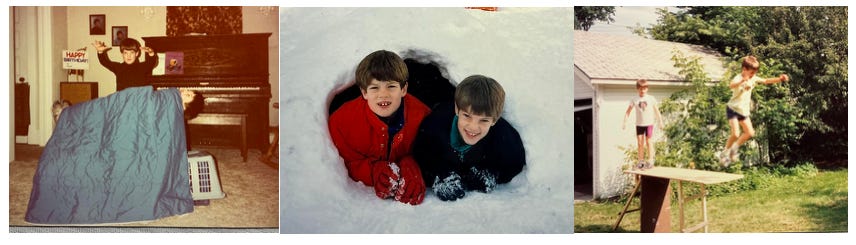
And to this day many of our ideas are forged through conversations with each other. Analyzing things like one’s visual perception has been readily more doable because we can compare what our individual experiences are of, say, looking at the same thing. I can think of times when we were kids, when we would close one eye and look at something and then close the other eye and say, you know, for me, this eye sees the scene slightly bluer, while my other eye sees it slightly more red. Is that the same for you? We could sort of share these very nuanced notes with each other. Or the way telephone poles receded into the distance as we sat in the back seat of a driving car and grew larger and larger till they passed on by, And that kind of sensibility, as we started to pursue art more seriously as teenagers and then art school students, led to a kind of art and art-making while specifically emphasizing the visual aspect of all that: how does looking at the world compare with looking at a painting? And why does any given painting make its impact upon us? What elements are carrying the painting? All of which was an ongoing outward conversation that we could have with each other.
Lawrence Weschler
At a certain point—this is jumping well ahead (and readers who are interested in pursuing the boys’s life story in more depth are invited to access my profile of them in the Virginia Quarterly Review as republished in expanded form in my own 2011 collection Uncanny Valley), but eventually you came to the Moment of the Thumb, as I’ve described it, which will be important in terms of explaining to people what’s going on with these concave drawings of yours. So why don’t you describe what happened there?
Trevor Oakes
Sure. So one of the conversations that we ended up having regarding perception involved having noticed the phenomenon of the double-image, which readers can see for themselves if they hold up one of their fingers at arm’s length, say their pinky or their thumb, and then, instead of looking at that digit, look beyond it into the distance. And the simple act of looking into the distance will cause an optical illusion to occur where the finger will appear to divide into a double of itself.
Lawrence Weschler
And in both cases, transparent.
Trevor Oakes
Indeed, because effectively what’s happening is that one eye is seeing the thumb from one vantage, and the other eye is seeing the same from another slightly different vantage. While the gazes from both eyes are converging beyond the thumb on that object in the distance.
Lawrence Weschler
Which incidentally is why a painter closes one eye as he puts out his thumb at arm’s length, so as to stabilize that effect as he or she susses out proportions in the distance. But presently you came to realize that there was something that you could do with the doubled image itself, right?
Trevor Oakes
Yeah, so we’d noticed the doubled-ghost-image, and we grew very interested in it because it was yet another of the kinds of secret, hidden aspects of our perception that we’d been investigating ever since toddlerhood. But it took two years to realize that there was anything that could be done with it.
Lawrence Weschler
And how old were you at this point?
Trevor Oakes
We realize its potential in our junior year of college. So we’re probably twenty, twenty-one.
Lawrence Weschler
And that’s at Cooper Union in New York.
Trevor Oakes
Yes. Upon first noticing the doubled image, we made some sketches of it and then just included those in the pile of sketches and general notes that we were continually compiling. But then, two years later, one afternoon we were sitting in Central Park and I was making a small sketch on a five-inch square notepad. It was an abstract doodle inventing the lines purely out of my imagination. And at some point I took a little break, sort of zoned out and glanced at the ground beyond the little sketchpad being held in my hand. And the simple act of looking beyond it onto the ground caused the sketchpad to split in two in such a way that the margin of the small sketchpad seemed to become optically transparent, such that the image of a small leaf laying on the ground appeared to be coming through the notepad. And, as my pen tip was stationed there, you know, ready to make a mark, all of a sudden, it was as if my pen tip was hovering on top of a real leaf on the page. And I realized I could just trace the contours of that leaf instead of inventing the mark out of my imagination, thereby letting the real world influence the abstract composition.
Lawrence Weschler
Now, the zone of transparency on the sketchpad page was maybe an inch, two inches, along the edge of the page. And effectively, when you thought about it, that was roughly the distance between your two eyes, or your two pupils to be specific. So you could trace that section and then theoretically you could fold that part of the page back and move on to the next part of the backdrop.
Trevor Oakes
Exactly. So I showed that to Ryan and we started discussing what could be done with that transparent margin onto which you could trace the background. And maybe a week later, we were at Union Square and Ryan suggested, let’s try that thing again. So at that point I was holding a larger sketchpad, so the margin was a bit taller. And I tried it again, this time holding the sketchpad perpendicular to the ground and tracing the array of hexagonal tiles that pave Union Square, looking straight ahead, drawing the foreground tiles large and then a little smaller, a little smaller, a little smaller as they shrunk into the distance.

Frankly, it got pretty tedious, tracing in the many, many tiles as they got smaller and smaller. But we realized that the rate of diminishing perspective was exactly correct as to how your eye perceived it. Which, having drawn such arrays of receding hexagonal tiles in college while studying linear perspective, we both knew was an incredibly complicated thing to plot because they have…
Ryan Oakes
…three sets of parallel edges.
Trevor Oakes
And each set of parallel edges is going to have its own vanishing point. So you’d have to do it in three-point perspective. And it was quite, quite laborious and tedious to plot that sort of scene using the geometric rules of perspective. Whereas by this method, we were getting this perfectly diminishing three-point-perspective of a hexagonal tile pattern as if for free, just lifting it directly from the world…
Lawrence Weschler
It was effectively a camera obscura or a camera lucida, though deploying no further equipment than your two eyeballs.
Ryan Oakes
Yes, yes, exactly.
Trevor Oakes
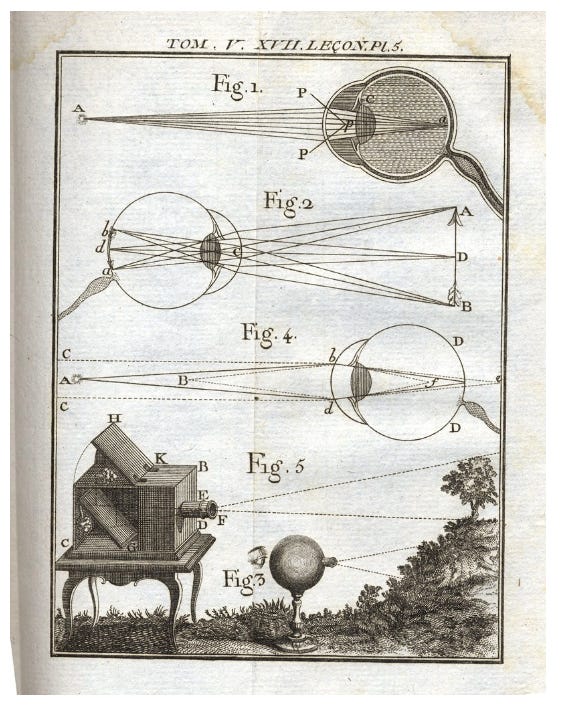
So a camera obscura is essentially a dark chamber with a lens slotted into the outer wall which projects an inverted image of the outside world onto the facing inner wall. And the interior of your eye is effectively likewise a dark chamber with a lens at the front, and the retina at the back, which would be where the artist positions their canvas in a typical room-sized camera obscura.
So you’re born with these two camera obscuras, your two eyes, side by side in your head and those two cameras are wired together into a unified image inside your brain. And it is this wiring that links those two images together that we are tapping into.
Lawrence Weschler
Another way of putting it is that ordinarily our brain supersedes what we actually see, as it were. When we look out into the world, we don’t see two images, but you were going back to what we actually do see, precognitively, before the brain gets its hands on the process. And you were putting yourself in a zone that allowed you to see both images separately and simultaneously—you were training yourself to see them both so that you could use…
Trevor Oakes
Right. So we could use the effect to capture these exact camera-obscura-like tracings of the world with no equipment except our own two eyes.
Lawrence Weschler
So that begins to be the method that you’re using. And I’ll note that to begin with you were doing urbanscapes as black ink drawings with a black ink pen. And at some point, you realized that there were all sorts of deformations happening when you just rendered things on a flat sketchbook piece of paper.
Ryan Oakes
Yes… So, as you say, we initially started deploying this optical method on flat sheets of paper but very quickly realized that all sorts of distortion began to creep in above and below and to the sides: that if you made an entire image across a flat piece of paper by drawing in one margin along the vertical edge and then folding the paper back and drawing in another margin and proceeding to fold it along like an accordion, you could indeed cover over the entire piece of paper with imagery, but these Mercator-like distortions would get introduced, where things in the center of the page would be pretty much in their appropriate scale, but as the imagery moved off to the edges and toward the corners, the objects being drawn sort of swelled in size and ballooned and got larger the same way that Greenland gets larger at the top of a Mercator map projection, where you’re taking the spherical globe of the earth and stretching the sphere onto a flat plane.
So how were we going to solve that? Essentially, we just ended up switching to drawing on spherically concave paper, you know, working on a sheet of paper that was molded into the shape of a part of the inner skin of a sphere where the vantage point would be positioned right in the center of that sphere, such that the relationship of the vantage to every point on that surface was the same. It was all equidistant. With that one move of taking the piece of paper from a flat plane and wrapping it into the inside of a portion of a sphere centered on the eye, we were able to eliminate all the distortions. And for that matter that was a truer-to-life way of depicting the actual feeling of being in the world.
Lawrence Weschler
In effect, you were mounting a critique of the Renaissance window-metaphor of the canvas as a rectangular hole in a wall that is, as it were, separating us from the world. That incidentally is what first got David Hockney so interested in what you were doing. And this will in turn be important presently when we talk about the Hudson River School painters, whose canvases were all still as if looking through a window, even though those guys were in a sort of imagined wilderness. The thing is, we don’t actually see the world like that. Rather, we in fact see the world as if we are on the inside, at the center point of a surrounding sphere. Which is why you eventually ended up needing to resort to this concavity in your depictions.
Ryan Oakes
Yeah, so making spherical paper was, as you know, a whole ‘nother thing in and of itself.
Lawrence Weschler
Among other things you needed to figure out a way that you could render more than just a vertical margin and draw into the middle of the page. Thus, once a vertical margin was drawn it needed to be moved out of the way so that it didn’t block the next portion of the view.
Ryan Oakes
Yes, we wound up advancing from one edge of the piece of paper to the other by way of slicing off each successive vertical strip as we completed it and setting it aside for reconstruction later.
The width that one can draw into this ghost margin, as we called it, was a little bit less than the separation of one’s two eyes. People’s eyes, on average, are about two and a half inches apart. We do a margin which is about two inches wide, that being the width that you can easily look past and cause that entire width to go optically transparent.
Lawrence Weschler
So eventually you ended up creating this meticulously curved concave grid easel mounted atop a tripod. I hope you will have one in the show so people can see what it looks like. {And they do.}

Trevor Oakes
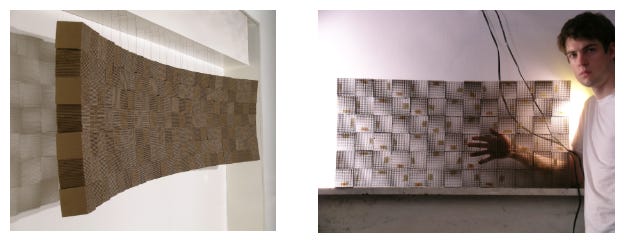
Exactly: the support structure of the easel upon which we would be laying in the image was curved to echo the curvature of the retina inside of the eyeball and, even more so, the curved nature of human vision itself. For one of the other conversations we had been having about perception was indeed about the very shape of one’s vision, the shape, that is, of the light coming into one’s eye. Through a series of sculptures, one made with hundreds of matchsticks and a subsequent one made of corrugated cardboard, we had realized quite assuredly that the shape of one’s vision is spherically concave, which is to say that at any given moment, you’re collecting all the rays that happen to be condensing onto your pupil, and that set of rays in their entirety are all perpendicular to a sort of implied sphere.

Lawrence Weschler
In fact there were such hemispheric splays all over the place in talking about light and vision. I remember the way you would talk about how if a ray of light from the sun hits any given spot in the world, that ray would splatter out into a hemisphere, as it were, of rebounding rays. And any single ray from that hemispheric splay would be one of those that hit your eye, bordered by a separate single ray from the hemispheric splay of those bounding up from a spot just to the side of that original spot. And the splay of rays converging on the pupil from the whole array of such spots in the eye’s surround would themselves converge hemispherically onto the pupil and then open out again hemispherically onto the curved retina on the far interior side of the eyeball. The eyeball itself in that sense working like a camera obscura, with a pinhole projecting the world outside upside down through a darkened surround onto the far wall beyond. Which, as you can see from contemporary illustrations, is where the early practitioners got the idea for a camera obscura.
Trevor Oakes
Indeed. At any rate, when it came time to build an easel that would allow us take on this optical doubleimage technique, to really formalize it and do it properly, we realized the easel needed to be spherically concave.
Ryan Oakes
But in that move, we simultaneously realized that there were a lot of cuts or shapes within the sphere that one could draw or paint on. For example, you could take an entire hemisphere, such that your canvas could be circular and half of a globe, or you could paint from within the interior of an entire globe. What we elected instead to do was to take a rectangular cropping of a sphere, as a direct nod to the traditional rectangular picture plane which has been so canonized throughout art history. We were moving away from the flat rectangle, but we still wanted to incorporate its psychological power, so we made a spherical rectangle.
Lawrence Weschler
And then again, you ended up having to create a kind of mad plaster helmet under a swivel joint that could stabilize the head that was looking out at the world beyond the curved easel, such that one of your eyes, I forget which one, stayed entirely fixed as if at the center of the curved surface throughout the operation as you rotated the rest of your head around in surveying the entire expanse of the scene before you.
Trevor Oakes
Yes, the left eye. So, yes, the vantage point of the person doing the drawing needs to stay very still. And so we built effectively an upside-down swivel-tripod for the head which positions the left eye at the exact center of the radius of the curved canvas, with the right eye off-center to the side, looking around the edge of the canvas at the real world while the left eye looks at the canvas. And then those two images, real world and canvas, get overlapped on top of each other in your brain because of the wiring that links the two eyes.
Ryan Oakes
The mad plaster helmet essentially provides a kind of gyroscopic motion about the left eye. You have a vertical axis and a horizontal axis of mobility that are in line with left eye such that your head can look up, down, and side to side without the left eye moving in space at all.

Trevor Oakes
And we would mount the spherical canvas on the easel, look past the margin and draw in that first vertical slice of the world, and then razor-slice it away and proceed to the next vertical, and so on, one margin after the next margin. Eventually we put the completed vertical rows all back together into the finished curved drawing—or alternatively we could begin with a single narrow vertical margin of canvas, fill that in, and then lay in the second vertical strip, and so forth.
Lawrence Weschler
For the first long while, you were only doing black-on-white ink or felt-tip drawing.
{NOTE: For an excellent short video documenting the whole process at the time the Twins were capturing a vista of the Flat Iron Building in New York City, see HERE}
Trevor Oakes
Yeah, so for about ten years, we made entirely drawings, most in black and white, and eventually some in color, though in fact only using five colored pens to achieve the entire spectrum of real-world hues. And then we shifted into painting.
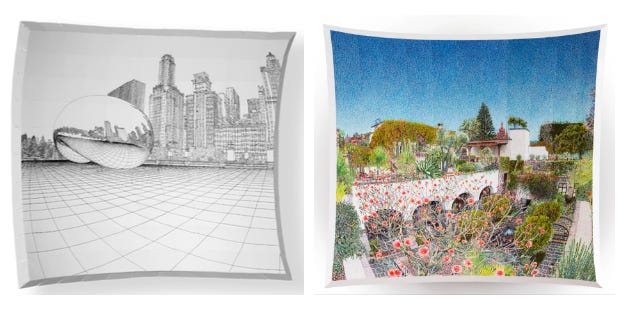
In particular we shifted into oil painting because we wanted to work in the winter when everything was frozen and oil paint was the only medium that would work well in frozen temperatures.
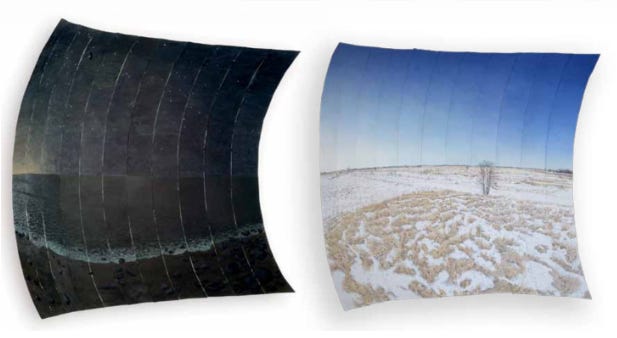
However, before we found our way to oil, our first concave painting ever was a watercolor made off Pacific Coast Highway in Los Angeles in 2010. Looking out at the Pacific Ocean, it was a nocturne, a nightscape of the very, very, very dark water with a very black horizon line and a very faintly glowing purplish brown sky above that, a night sky with stars.
The progression here is that we realized that when you’re drawing with black and white lines—at least the way we were doing it in the early drawings using contour outlines—we were talking entirely about form and space, but we weren’t really talking about light. Whereas thinking about the shapes light moves in as it travels through the air and into our eyes had been the guiding motivating vehicle carrying us through this entire progression going back to the very beginning. So the fact that light was not part of the subject matter was a little bit of a miss. So we decided we were going to shift gears and move into the territory of light. And initially we did it very specifically by dropping as much form as possible: focusing on the flat plane of the water, the horizon line and the sky, an environment with very little form. Light is present in this environment but only a little bit. So we decided to start at this very, very dark end of the color spectrum where light was there but only just barely beginning, sort of like Let There Almost Be Light—just a whisper. This dim light manifests as color, subtle as it may be, and our goal was to see if we could get a similar sense of depth in the paintings just through color as we had gotten with lines in the earlier drawings.
Ryan Oakes
Right. So, we started in whisper-light territory, did this really, really dark nocturne, then we wanted to do another piece, but at the opposite, brightest-white end of the color spectrum. Like let there be so much light that it’s nearly blinding. But we also still wanted it to be a flat, nondescript vista with minimal forms. And as it happened, we’d been offered a show at Laurel Reuter’s North Dakota Museum of Art in Grand Forks. And outside town we managed to find a vast snow-covered field. And there you couldn’t use watercolor because the watercolors would have frozen on the palette—they would have been icecolor. They simply wouldn’t work. Oil, on the other hand, stays very supple, kind of like soft butter, even when it’s really cold. So we figured out the technique for using oil in North Dakota that we returned to using once again, with far greater color variety, a few years later on the Hudson River.
Lawrence Weschler
Indeed, in between you focused on other sorts of vistas, Central Park and that Mexican Garden come to mind, and a series of mountainscapes there in North Carolina where you are zoom-calling in from today, a particularly rich one as I recall of the forested view from a cliffside outcropping. Which is to say that even before you began your own Hudson River series, you were drifting into the Hudson River School kind of iconography in terms of the beauty of the whole wide world, which becomes particularly pertinent because we’re also drifting into the late Hudson River School subgenre of so-called Luminism. The beauty of the world, but it’s also the beauty of light.
Trevor and Ryan Oakes
Yes, yes, yes.
Lawrence Weschler
Which brings us back to that observation with which we began in terms of Emerson and transcendentalism, that being the same literary tradition that so influenced American artists in the Hudson River School, but also straight on through, even if only subliminally, to Rothko and Reinhardt and Guston and then Robert Irwin and James Turrell and the other artists in the California Light and Space movement who I know meant a whole lot to all three of us.

The way in which there is the phenomenon of the light in the world but also the kind of answering light that gets referred to as the light of perception, the internal spark that brings us back to Emerson’s contention that the lover of nature is he whose inward and outward senses are truly adjusted to each other. The light of attention, which feeds back into the whole tradition of the light of reason.
Ryan Oakes
Yes, absolutely.
Lawrence Weschler
By the way, how is it different to paint than to draw?
Ryan Oakes
Painting is actually a lot faster.
Trevor Oakes
When you’re drawing, at least the way that we decided to draw, you start by honing in on edges. Whereas when you’re painting, you start in the middle and work out. So, perceptually, as you look out at the scene and decide what you’re going to do, there is a big difference. Let’s say a leaf: If you’re painting, you start by rendering the middle of that leaf and working out to the edges. If you’re drawing it, you start by outlining the perimeter and work your way in.
Ryan Oakes
With drawing, you can do a lot more detail. You have a very thin pen tip where you can articulate, say, the veins of an individual leaf or the branching of an individual twig. When you’re painting, the strokes are much larger, so you have to sort of generalize an overall feeling.
Lawrence Weschler
In a sense, you’re focusing on two different aspects or registers of perception.
Ryan Oakes
Right. It’s like different layers of perception. I feel like the perception of edges comes before that of color. Such that the progression that we were doing with first drawing contour lines and then eventually moving into color is perhaps sequenced similarly to how the brain processes what it’s seeing.
Trevor Oakes
Quite literally edges and color are processed in different layers in your visual cortex. Simplifying somewhat, edges are processed primarily in the first layer, referred to as V1, whereas the rich experience of color you enjoy becomes fully realized subsequently in deeper layers of the visual cortex, such as V2, V4 and V8.
Lawrence Weschler
It’s interesting that black and white cinema happened before color cinema.
Ryan Oakes
Yeah, right. Right.
Trevor Oakes
Yeah, when wrapping the chemical photography around capturing photons, at first it was probably easier to get something to turn a gradient of black to gray to white.
Lawrence Weschler
But anyway, at a certain point, you end up on the Hudson River—just like those 19th-century Hudson River School guys before you. Was that just a complete coincidence, or what was happening there?…
* * *
To be continued next week!
Lovely that they started using oils because watercolors would freeze - "ice-colors, which wouldn't work." When christine was a painter she also used oil paints for their suppleness.
I love the kiddie photos of the boys. They should use one as their bio pic! Give them my regards - wish I was in NYC to see the show. Fingers crossed for some stellar sales.