

WELCOME
While Ren is in Madrid these next few weeks, working on a Spanish updated edition of his Miracle/Universe book on Settling Accounts with Torturers in Latin America, we in turn will be offering a series of reprise issues, for starters this one—and this one isn’t even a reprise exactly, which is to say that only some of its contents appeared in those Footnotes to that Book Yet to be Published that we were parlaying in some of our earliest issues…
*
From the Archive
…But the actual story is that back in 1985, when Ren was still relatively new at the New Yorker, Mr. Shawn sent him a note asking whether he might like to try his hand at submitting fiction, and he replied with a long note back, which Mr. Shawn proceeded to run as the next week’s otherwise anonymous lead Note and Comment. This was right around the time that Larry McMurtry’s Lonesome Dove had first been published, and so Ren had lassoed that book into his note back to Mr. Shawn—all of which came surging back to memory for us here at the Cabinet this past week, what with that book’s incomprehensible failure to show up anywhere on the Guardian’s recent “100 Best Novels of All Time” list, an omission which still leaves us stupefied. But anyway, here’s this:
WHY I CAN’T WRITE FICTION
The New Yorker, August 26, 1985
A young reporter we know writes:
Friends of mine sometimes ask me why I don’t try my hand at writing a novel. They know that novels are just about all I read, or, at any rate, all I ever talk about, and they wonder why I don’t try writing one myself. Fiction, they reason, should not be so difficult to compose if one already knows how to write nonfiction. It seems to me they ought to be right in that, and yet I can’t imagine ever being able to write fiction. This complete absence of even the fantasy of my writing fiction used to trouble me. Or not trouble me, exactly—I used to wonder at it. But I gradually came to see it as one aspect of the constellation of capacities which makes it possible for me to write nonfiction. Or, rather, the other way around: the part of my sensibility which I demonstrate in nonfiction makes fiction an impossible mode for me. That’s because for me the world is already filled to bursting with interconnections, interrelationships, consequences, and consequences of consequences. The world-as-it-is is overdetermined: the web of all those interrelationships is dense to the point of saturation. That’s what my reporting becomes about: taking any single knot and worrying out the threads, tracing the interconnections, following the mesh through into the wider, outlying mesh, establishing the proper analogies, ferreting out the false strands. If I were somehow to be forced to write a fiction about, say, a make-believe Caribbean island,

I wouldn’t know where to put it, because the Caribbean as it is is already full—there’s no room in it for any fictional islands. Dropping one in there would provoke a tidal wave, and all other places would be swept away. I wouldn’t be able to invent a fictional New York housewife, because the city as it is is already overcrowded—there are no apartments available, there is no more room in the phone book. (If, by contrast, I were reporting on the life of an actual housewife, all the threads that make up her place in the city would become my subject, and I’d have no end of inspiration, no lack of room. Indeed, room—her specific space, the way the world makes room for her—would be my theme.)
It all reminds me of an exquisite notion advanced long ago by the Kabbalists, the Jewish mystics, and particularly by those who subscribed to the teachings of Isaac Luria, the great, great visionary who was active in Palestine in the mid-sixteenth century.

The Lurianic Kabbalists were vexed by the question of how God could have created anything, since He was already everywhere and hence there could have been no room anywhere for His creation. In order to approach this mystery, they conceived the notion of tsimtsum, which means a sort of holding in of breath. Luria suggested that at the moment of creation God, in effect, breathed in—He absented Himself; or, rather, He hid Himself; or, rather, He entered into Himself—so as to make room for His creation.
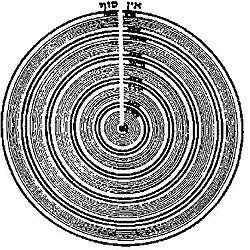
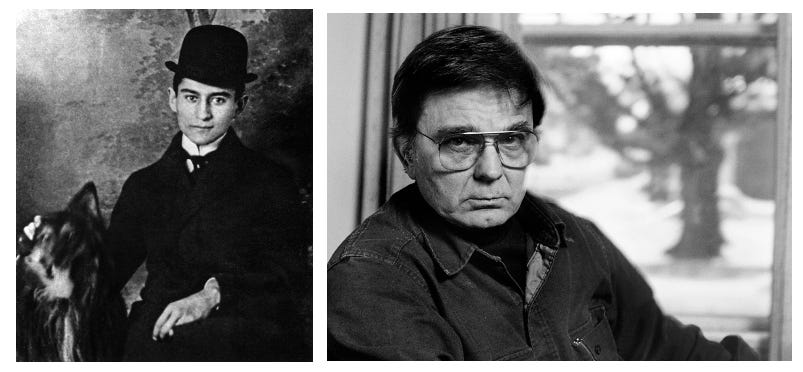
This tsimtsum has extraordinary implications in Lurianic and post-Lurianic teaching. In a certain sense, the tsimtsum helps account for the distance we feel from God in this fallen world. Indeed, in one version, at the moment of creation something went disastrously wrong, and the Fall was a fall for God as well as for man: God himself is wounded; He can no longer put everything back together by Himself; He needs man. The process of salvation, of restitution—the tikkun, as Luria called it—is thus played out in the human sphere, becomes at least in part the work of men in this world. Hence, years and years later, we get Kafka’s remarkable and mysterious assertion that “the Messiah will come only when he is no longer needed; he will come only on the day after his arrival; he will come not on the last day but on the very last.”
But I digress. For me, the point here is that the creativity of the fiction writer has always seemed to partake of the mysteries of the First Creation (I realize that this is an oft-broached analogy)—the novelist as creator, his characters as his creatures. (See, for example, Robert Coover’s marvelous The Universal Baseball Association, Inc., J. Henry Waugh, Prop., in which for “J. Henry Waugh” read “Jahweh.”) The fictionalist has to be capable of tsimtsum, of breathing in, of allowing—paradoxically, of creating—an empty space in the world, an empty time, in which his characters will be able to play out their fates. This is, I suppose, the active form of the “suspension of disbelief.” For some reason, I positively relish suspending my disbelief as long as someone else is casting the bridge across the abyss; I haven’t a clue as to how to fashion, let alone cast, such a bridge myself.
All these thoughts have come to the fore for me just now on account of my recent summer reading. Larry McMurtry, one of my favorite novelists, has a big new novel out, the epic that all of us McMurtry fans have been hearing rumors of for years.
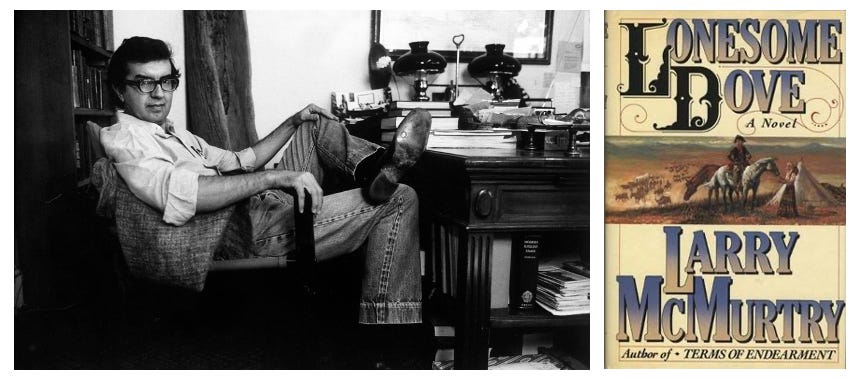
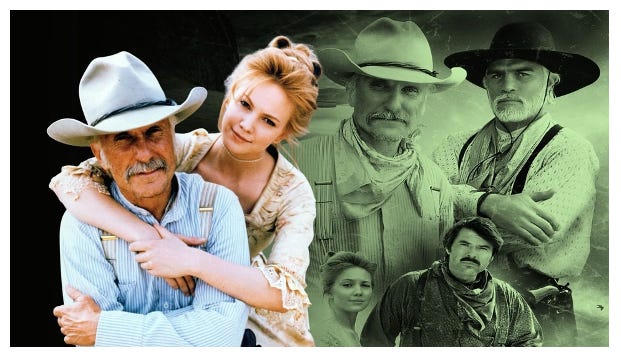
It’s called Lonesome Dove; it basically concerns a cattle drive from southernmost Texas all the way to the highlands of Montana back in the late 1870s, around the time Montana was beginning to be made safe for settling (or, actually, as the novel reveals, it was at precisely this time that brash exploits by characters such as these were going to make that north country safe for settling, although it sure as hell wasn’t yet); and it’s a wonderful book. McMurtry’s ongoing capacity for fashioning fully living characters—filled with contradictions and teeming with fellow-felling—is in full bloom here; he’s created dozens of them, and he’s managed to keep them all vividly distinct. Reading the book, one begins to think of the novelist himself as trail driver, guiding and prodding his characters along: some tarry; others bolt and, after a long, meandering chase, have to be herded back into the main herd; others fall out and stay behind; still others just die off. Why does he, I marvel—how can he—keep driving them along like that, from the lazy, languid Rio Grande cusp of Chapter 1 to the awesome Montana highlands past page 800? In many ways, McMurtry strikes me as not unlike his character Captain Call, the leader of the drive, who just does it, and keeps on doing it as, one by one, all conceivable motivations and rationales slip away. And yet, unlike Call, McMurtry seems overflowing with empathy for every one of his creatures—a lavishment of love which makes his ability, his negative capability, to then just let them go (after lavishing so much compassion in the fashioning of them), to just let them drift into ever more terrible demises—all the more remarkable.
I have so many questions I’d like to ask McMurtry about how he does it. But he wouldn’t much cotton to my coming around and asking them. I know; I tried once. McMurtry lives part of the time in Washington, D.C., these days, where he runs a rare-book emporium in Georgetown. I remember, about five years ago, arriving by train at Union Station and looking up the store’s name in the phone book and calling the number from a pay phone and asking the answering male voice whether Mr. McMurtry was in and being told yes, it was he speaking. I said, “Great, don’t move, I’ll be right over.” I hailed a taxi and was there in less than ten minutes. I started out pouring forth praise and appreciation and heartfelt readerly thanks, and then headed into my few questions. And all the while he stared back at me, completely indifferent. The sheer extent of his indifference was terrifying. I ended up stammering some sort of gaga apology and bolting.
A few weeks ago, two of McMurtry’s more recent novels were reissued in paperback—timed, I suppose, to coincide with the hardcover publication of Lonesome Dove. They included new prefaces, and these prefaces helped me to appreciate the icy reluctance to talk about his own writing with which he’d greeted me that day. “I rarely think of my own books, once I finish them,” he records in the preface to Cadillac Jack, “and don’t welcome the opportunity, much less the necessity, of thinking about them. The moving finger writes, and keeps moving; thinking about them while I’m writing them is often hard enough.” In the preface to The Desert Rose, he plays a variation on this theme: “Once I finish a book, it vanishes from my mental picture as rapidly as the road runner in the cartoon. I don’t expect to see it or think about it again for a decade or so, if ever.” But those prefaces nevertheless suggest the contours of some answers to the sorts of questions I wanted to ask: questions about creators and creatures, free will and determinism—finally, I guess, about grace. At one point, he writes about the way one of his characters, Harmony, in The Desert Rose, “graced” his life during the time he was writing about her. (That’s a good, an exact, word; I remember how she graced my life, too, as I read about her.) “In my own practice,” he notes, “writing fiction has always seemed a semiconscious activity. I concentrate so hard on visualizing my characters that my actual surroundings blur. My characters seem to be speeding through their lives—I have to type unflaggingly in order to keep them in sight.” Later, he records that he was “rather sorry,” as he finished the book’s composition, when Harmony “strolled out of hearing.”
Characters stroll out of hearing all the time in Lonesome Dove, and strolling’s not the half of it. They lurch, careen, and smash out of hearing: they get snake-bitten, drowned, hanged, gangrened, struck by lightning, bow-and-arrowed. The untamed West of Lonesome Dove is a tremendously dangerous wilderness. McMurtry offers a luminous epigraph to his epic, some lines from T. K. Whipple’s Study Out the Land: “All America lies at the end of the wilderness road, and our past is not a dead past, but still lives in us. Our forefathers had civilization inside themselves, the wild outside. We live in the civilization they created, but within us the wilderness still lingers. What they dreamed, we live, and what they lived, we dream.” It occurs to me that as a reader I stand in somewhat the same relationship to McMurtry as that which Whipple suggests obtains between us and our forebears. Here McMurtry has gone and done it—created this tremendous epic massif. All the while, as he was doing it, he must have been envisioning us someday reading this epic; and now we, as we read it—or, anyway, I, as I read it—try to imagine what it was like for him doing it, making it, living through the writing of it. And the thing I keep wondering about, in my clumsy, gawky fashion, is this: Did he, too, feel the sorrow, the poignant melancholy, that he engenders in us as, one by one, he disposed of those, his beloved characters; or was he able merely to glory in the craft of it, the polish, the shine? Are they—his characters—more or less real for him than they are for us?
* * *
See you next week!