

You all probably know the one about the guy who goes to a shrink and says, “Doctor, doctor, you gotta help me, I’ve got…” and the Doctor says, “Wait, wait, don’t tell me, let’s just do this little test and I’ll be able to tell you what your problem is,” at which point the shrink pulls out a pile of cards and tells the guy to relate his first associations with regard to each of the coming sequence of images, for instance this one here (two parallel vertical lines), at which point the guy blanches: “Oh my god, that’s two people kissing and it’s completely disgusting.” Hmm, responds the shrink, scribbling a note to himself, before continuing, And how about this one? (two parallel horizontal lines): “Oh my god,” gasps the guy, “that’s two people and they are having, ick, sex and it’s really disgusting.” Hmmm, scribbled note, next up (two lines crossing in an X), at which point the guy veritably screams, “Oh my god!” Whereupon the shrink summarily suspends the test and simply pronounces, “We don’t need to do any more, I can tell you what your problem is: you have a pathologically dirty mind!”
“I’ve got a dirty mind!?” retorts the patient—“You’re the one showing me the dirty pictures!”
A story I in turn offer up at the outset here as, I suppose, a mild sort of trigger warning, but more to the point, pithed of any of its “dirty” connotations—indeed, to the contrary!—an intimation of the sort of free associations upon which I intend to embark in the paragraphs that follow.
For I want to suggest that for another few weeks anyway (that is, until August 23), two of the most exquisitely sensual and erotic paintings of all time will be residing fewer than a hundred yards from each other at London’s National Gallery, for the first and likely last time ever.
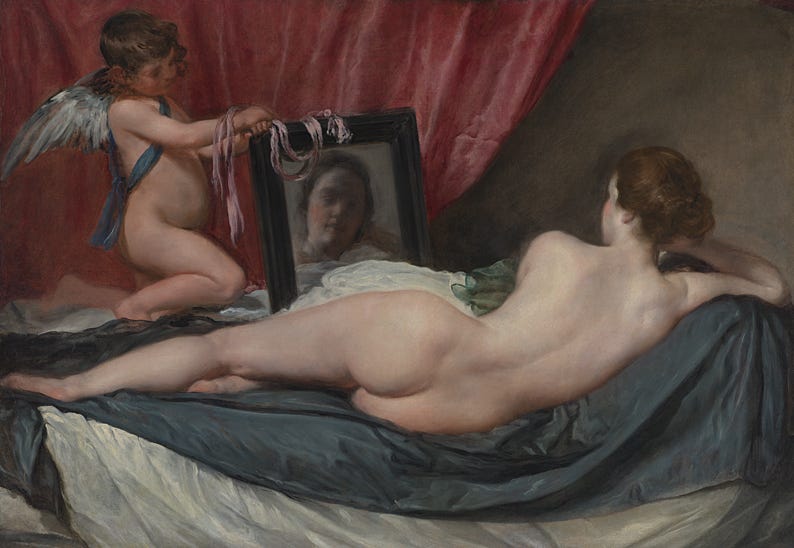
Originally painted less than fifteen years apart by two almost exact contemporaries, I am speaking of course of Velásquez’s so-called Rokeby Venus (which is always there at the National)
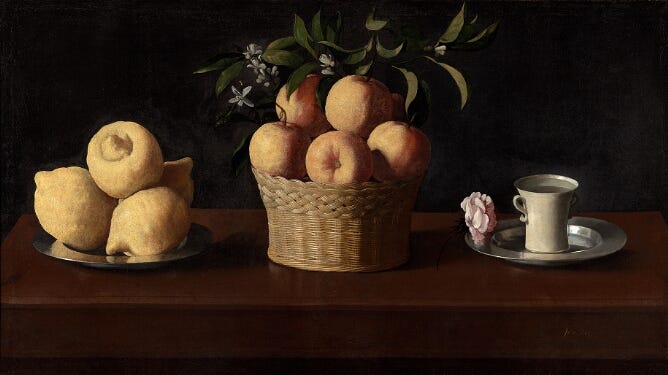
and Zurbaran’s Still Life with Lemons, Oranges and a Rose, which nowadays ordinarily resides at the Norton Simon Museum in Pasadena but this summer holds pride of place as the climactic canvas in the National’s sumptuous (unprecedented and itself perhaps never to be repeated) Zurbaran retrospective (closing, alas, as I say, on August 23rd).
Now, the case for the former is pretty obvious and has been made many times before, and in fact we ourselves have already considered the painting at some length right here in this Cabinet (back in Issue 11 in the prolog to our Taxonomy of Convergent Effects series), where we focused on the nude’s landscapelike horizonwide expanse, on the one hand,
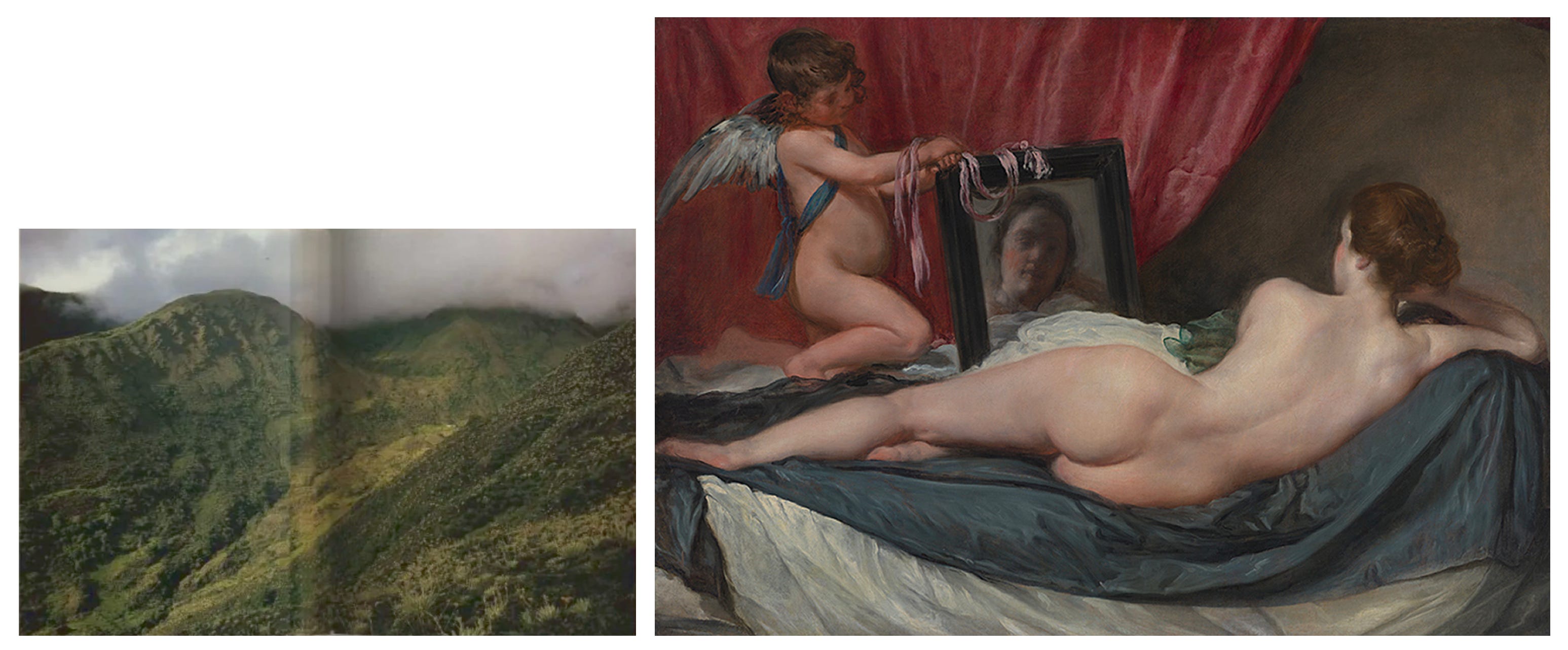
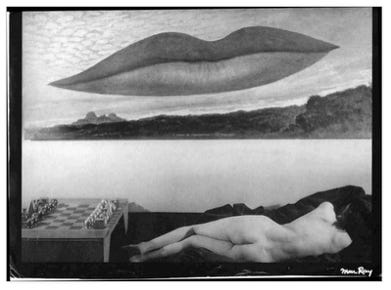
and conversely, the way that, when combined with the sweep of the black satin sheet below, the outstretched body reads as the top one of a pair of lips, indeed the very lips that centuries later a despairing Man Ray would stretch across the evening sky in his Hour of the Observatory,

memorializing the lips of his suddenly departed lover Lee Miller, and if you don’t think Man Ray had that very painting in mind when he painted those lips, take a look at the photograph he himself took not long afterwards:
But today I want to focus on another aspect of the Velásquez Venus’s startling appeal: the goddess’s face in the mirror. For there has been a long tradition in Western art of men painting women looking at themselves in the mirror as archly moralizing emblems of female vanity or self-absorption which somehow try to excuse or displace the avidity of the men’s own gaze (both the painter’s and that of his client). But that is not at all what is going on in this painting. It has often been noted that the painting seems to take off from two of the greatest paintings of the prior century, both by Titian, in many ways Velásquez’s own supreme master.
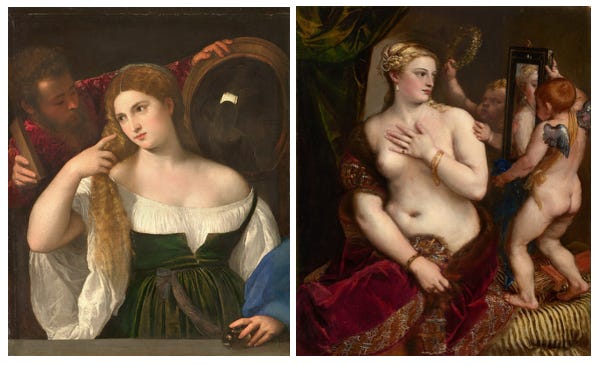
In the earlier Titian, the woman is actually looking at herself in two mirrors, both in front and in the back, so absorbed is she in her vain preparations; in the latter, Venus may have started out appraising herself but she would seem to have just noticed us looking at her. In the Velasquez, though, and for the first time as far as I know in the history of Western Art, the goddess, in full self-possession of her own relaxed body, is looking not at herself but rather straight at us, appraising us, fixing us with her sovereign stare.
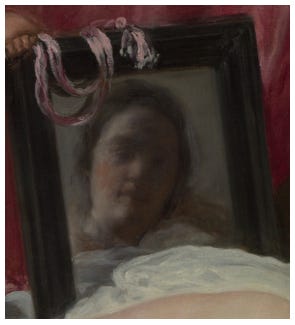
“For there is no place that does not see you” (with Rilke being stared down by a Torso of Apollo): We must change our life!
*
Now, granted, the Zurbaran is less obviously—or should I say less overtly—an erotic painting, but I would like to suggest that it is just as powerfully charged along those lines, which in no small part accounts for its magisterial appeal (many consider it the greatest still life of all time). Zurbaran of course was not a court painter and he hence lacked some of the liberty that Velásquez could take for granted; his clients were largely monasteries and other religious patrons and his subjects mainly themselves religious.
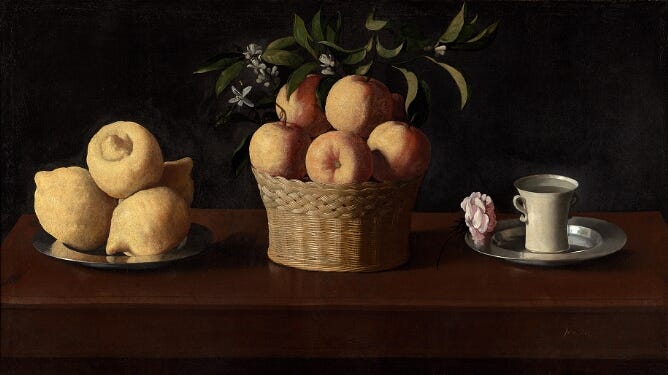
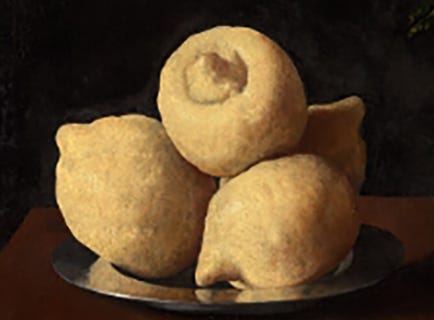
But just look at that painting again: the nipply lemons, the navel oranges (with the one orange’s very navel conspicuously turned out towards us at the very fulcrum of the entire expanse); and then that clitoral cup handle and the pubic rose off to the right. I’m sorry, I am not making this up: this was the closest Zurbaran himself ever came to painting an elongated nude (in this instance, for another surrealist correlative, compare René Magritte’s vertical version, The Eternally Obvious, at the Met) and it is dazzlingly erotic; and yet, as with the Velásquez, the painting’s manner of addressing us (its one-eyed navel gaze, as it were) is profoundly existential as well, and I daresay religious. Religion, as my composer grandfather always liked to point out, in its original Latin meaning, re-ligare, which is to be tied (as in ligature), tied back into the originary loam of existence. For Zurbaran’s entire oeuvre, and perhaps nowhere as profoundly as here (although in this context consider, too, his ravishing, similarly stretched-out Agnus Dei of 1640, and compare the lamb’s snout with the Still Life’s nipply lemon), is deeply incarnational, suffused, that is, with the mystery and grace of divine incarnation.

*
The two paintings, I am trying to say, the Velásquez and the Zurbaran, ought to be seen as virtual companion pieces in that regard (even if they can only physically be seen like that for the next couple weeks).
That regard, in turn, being being defined in Miloszian terms—or at any rate those of the octogenarian Czeslaw Milosz, who in his “Honest Description of Myself with a Glass of Whiskey at an Airport in, Let Us Say, Minneapolis,”
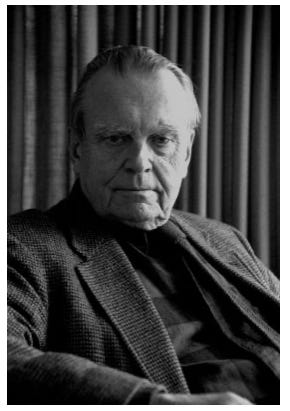
confesses as to how, well past his sell-by date, he goes on ogling the passing parade of young women in their miniskirts, insatiably, wildly inappropriately, and yet, as he goes on to say:
…I do what I have always done: compose scenes of this earth under orders from the erotic imagination.
It’s not that I desire these creatures precisely; I desire everything, and they are like a sign of ecstatic union.
It’s not my fault that we are made so, half from disinterested contemplation, half from appetite.
And in that spirit, I too would like to consider the way those two Spanish masters of the Seventeenth Century afford a breathtaking vision of the complex overlay between the erotic and the divine: a whiff, a pang of the Love Eternal.
*
POSTSCRIPT
THE GIANT AT THE PRADO REDUX
Meanwhile, some of you will remember that strange “Colossal Head” surmounting the stairwell at the Prado which we discussed back in Cabinet issue #16 (for anyone who actually saw the thing in person, it was pretty hard to forget).

Back then (just a few years ago), it was still being attributed to a relatively minor Italian master, Vincente Carducho (1576-1638), but in the meantime it has undergone a decided upgrade and is now seen to have been a Zurbaran all along (indeed it is now understood to have graced a stairwell in the Buen Retiro royal palace in Madrid where it hung alongside several of Velásquez’s dwarves!) and as such has been included as one of the further stand-out revelations in the current London National Gallery show.

And talk about a pair of lips!
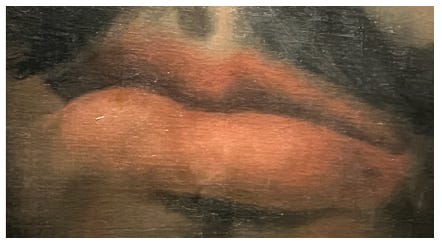
Ooof! Good lord.
* * *
See you next week!