

WONDERCABINET : Lawrence Weschler’s Fortnightly Compendium of the Miscellaneous Diverse
WELCOME
A look back at the BBC documentarian Adam Curtis’s evocation of the originary taproots of the 9/11 attack by way of its pervasive premonitions in the American pop-culture of the immediately preceding decades—imagery that, Curtis suggests, may well have given Osama bin Laden and his cohort the very idea in the first place…
*
As most of you will no doubt have noticed, we are on the cusp of yet another one of those massively regimented rituals of national commemoration, in this instance regarding the coming 25th anniversary of Al Qaeda’s devastating 9/11 attack on the World Trade Center. As is sometimes the case, we here at the Cabinet try to approach such extravaganzas at a sort of slant remove, and this time we propose to do so by way of a triptych of vantages spread over our next three issues, sequentially plumbing, as its were, the event’s prehistory, its ongoing presence, and its long-term future. And so, to begin with, there’s this:
The AV Room
Adam Curtis on the American pop-cultural taproots of the entire 9/11 debacle
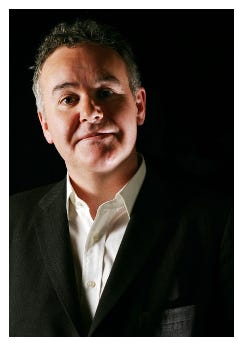
To characterize the BBC’s Adam Curtis as a documentary filmmaker is, I suppose, right as far as it goes, but it’s a bit like describing Keith Jarrett as a mere piano player: there’s that but so much more. Indeed, considered by the likes of Errol Morris and Walter Murch to be one of the most fascinating filmmakers operating in the world today, Curtis is hardly a documentarian at all, at least in any conventional sense: wildly heterodox in his interests, thrillingly daring in his associative leaps, extravagantly assured in his claims, he is in fact more like a jazz virtuoso, his instrument being the BBC’s legendary century-old archive, the cavernous entirety of which (both aired material and all the outtakes that went into making them) he seems to have at his very fingertips . He regularly engages in a kind of mind-jazz, assuming a certain common knowledge, say, about the historical past, but then unfurling a sequence of startlingly fresh riff-like variations on all manner of conventional assumptions, buttressed by the most startlingly apt series of long-lost video snippets. What would it be like, he seems to ask, if instead we looked at things like this, or like this, or in fact like THIS—would we ever be able to look at them that same old way again?
I myself first became aware of Curtis by way of two of his most sublimely discombobulating documentaries, Century of the Self, his four-part 2002 series tracing (among other things) the way the teachings of Vienna’s Sigmund Freud got transmogrified as they made their way into American corporate public relations and mass-advertising consumer culture by way of the far-flung machinations of Freud’s nephew Edward Bernays (trailer here and full series here); and The Power of Nightmares, his three-part 2004 history of the way that neocon Western neoliberals and Islamic fundamentalists wove in and out from cynical alliance to fraught enmity in a decades-long mutual project, replacing the politics of hope with the politics of fear, to devastating effect (trailer here and full series here).
By 2013, in an attempt to break out of the straight-jacket of conventional television based programming, Curtis entered into a deep collaboration with the Bristol-based trip-hop collective Massive Attack. Together, they tried to evolve a new way of doing documentary—a kind of full-bore son et lumière sensory-onslaught archival-footage extravaganza. The result—a complicated performance piece, with music, spoken word, and footage simultaneously projected over eleven screens and channeled back through dozens of booming loudspeakers—was Massive Attack v. Adam Curtis, which premiered at the Manchester International Festival and by late September was alighting at New York’s Park Avenue Armory.
The trailer promised that, somehow, Curtis and Robert “3D” Del Naja (his principal Massive Attack interlocutor) would be weaving the stories of “Donald and Ivana Trump, Nicolai and Elena Ceausescu, Jane Fonda and Ted Turner, Hamid Karzai and his brothers, everyone in Goldman Sachs who made a killing in 2008, the neutron bomb, the Siberian punk movement, Bambi, and all your worst fears.” And in the event it managed to braid in all of that and far more.
At the time I profiled Curtis and previewed the upcoming Park Avenue engagement in a piece for New York magazine, which you can access HERE . But for our purposes today, I want to sample a four-minute passage from the event itself—try to imagine the sequence you are about to see being channeled through eleven screens ranged all about in the round with the band’s pounding propulsive accompaniment welling up from somewhere behind the screens—in which the team move from a consideration of Putin’s growing suspicion of democracy to a similar move on the part of Islamic fundamentalists and on to….well, see for yourself:
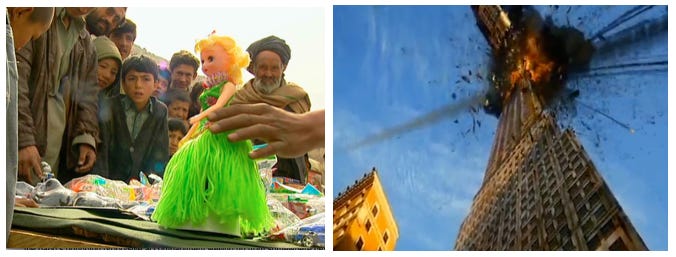
View film passage HERE.
And so we are off. Stay tuned across our next two issues for further considerations athwart the coming 9/11 commemorations, the first, next week, regarding the catastrophe’s ongoing presence, and the second, in two weeks, about the future of that presence.
* * *
ANIMAL MITCHELL
Cartoons by David Stanford, from the Animal Mitchell archive.
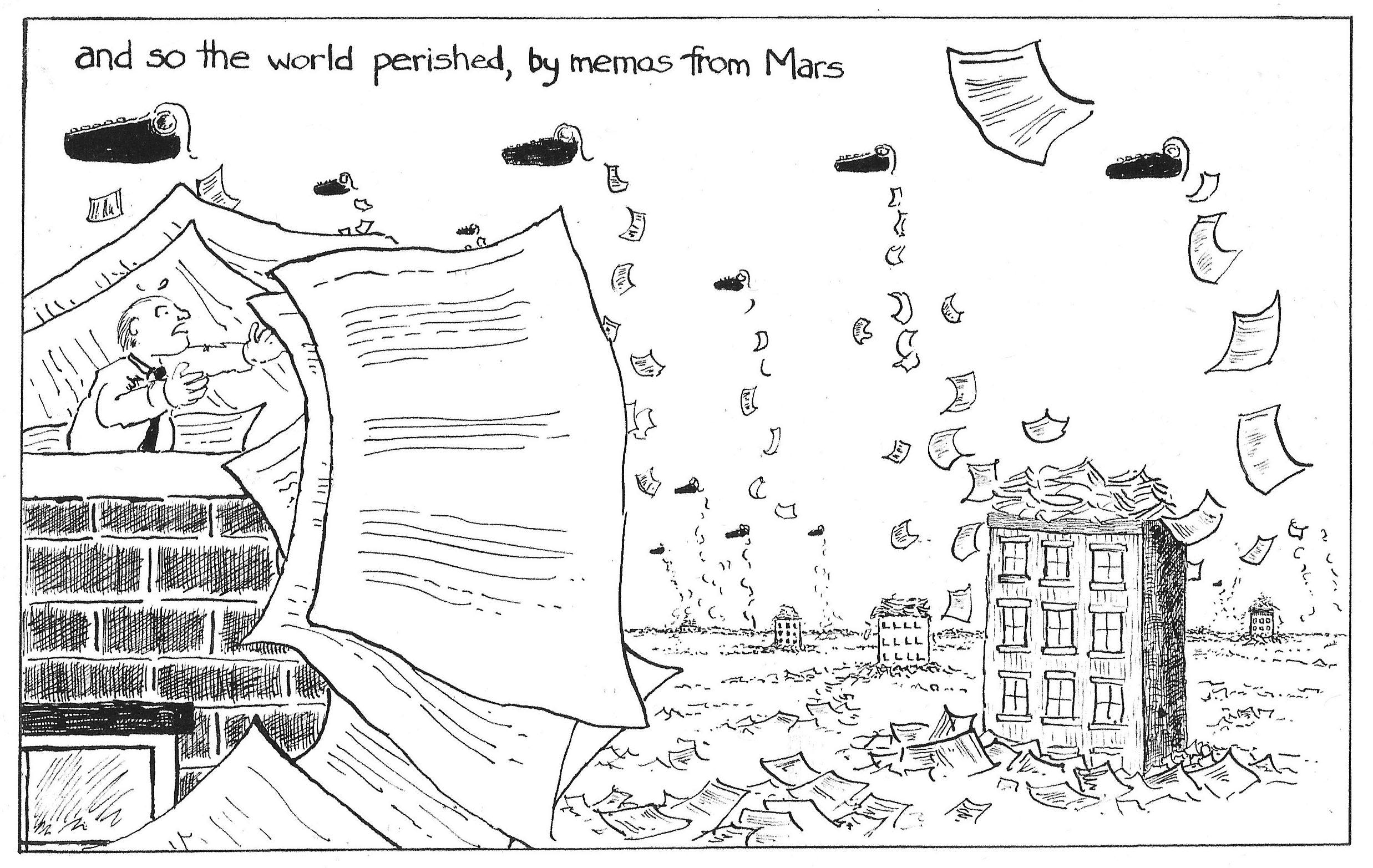
You can order a four-booklet Animal Mitchell starter kit here. And please check out Weekly Strip.
* * *
Aslant, athwart, however you like, do please consider becoming a paid subscriber.
NOTE: For those of you who can’t afford a paid subscription right now, you can still access a free option by clicking HERE and selecting the option on the far right.
Thank you for giving Wondercabinet some of your reading time! We welcome not only your public comments (button above), but also any feedback you may care to send us directly: weschlerswondercabinet@gmail.com.
Here’s a shortcut to the COMPLETE WONDERCABINET ARCHIVE.
Holy smokes, that video is wild. Thank you, glad to know about it.